Learn what every symbol on the card means.Full credits and sources at beakbrain.com/symbols
 RockyCup nestSmall · 21 g


ID tip
The large rock martin of the nominate subspecies P. f. fuligula is 12–15 cm (4.7–5.9 in) long, with earth-brown upperparts and a short square tail that has small white patches near the tips of all but the central and outermost pairs of feathers. It has a cinnamon chin, throat, upper breast and underwing coverts, with the rest of the underparts being a similar brown to the upperparts. The eyes are brown, the small bill is mainly black, and the legs are brownish-pink. The sexes are similar in appearance, but juveniles have pale edges to the upperparts and flight feathers.
Text from Wikipedia, licensed CC BY-SA 4.0.
When to see the Large Rock Martin
One bar for each month, and every month is filled: this bird is recorded here in all twelve. The wide bar is October, the month with the most records.
Where to see the Large Rock Martin
The map shades 35 countries with regular records, and 2 more in a lighter tone where the bird turns up only as a stray. Everything unshaded has no records. Countries are listed below the map.
About the Large Rock Martin
The large rock martin, also known as the southern crag-martin, is a small passerine bird in the swallow family that is resident in southern Africa. It was formerly considered to be conspecific with the red-throated rock martin. It breeds mainly in the mountains, but also at lower altitudes, especially in rocky areas and around towns, and, unlike most swallows, it is often found far from water. It is 12–15 cm (4.7–5.9 in) long, with mainly brown plumage, paler-toned on the upper breast and underwing coverts, and with white "windows" on the spread tail in flight. The sexes are similar in appearance, but juveniles have pale fringes to the upperparts and flight feathers.
Text adapted from Wikipedia, licensed CC BY-SA 4.0.
Easily confused with
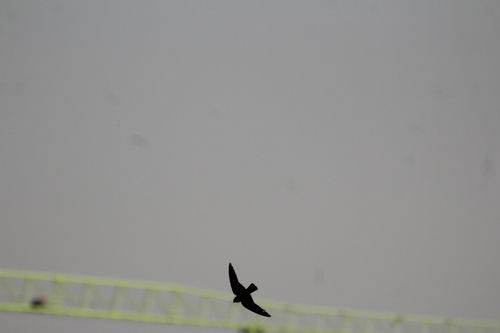 Dusky Crag MartinPtyonoprogne concolorThe dusky crag martin is 13 cm (5 in) long with a broad body, wings and tail.
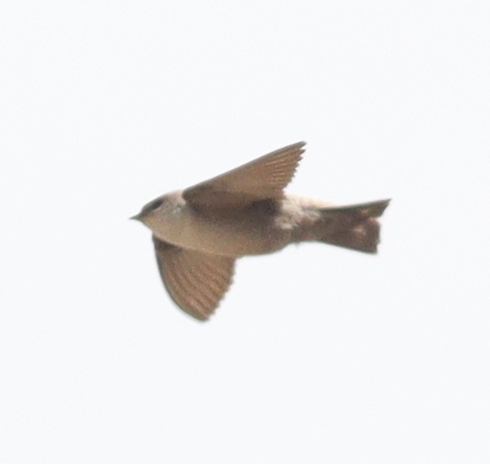 Pale Crag MartinPtyonoprogne obsoletaThe pale crag martin of the nominate subspecies P. o. obsoleta is 12–13 centimetres (4+1⁄2–5 inches) long with light brown upperparts, becoming paler on the lower back, and a short square tail that has small white patches near the tips of all but the central and outermost pairs of feathers.
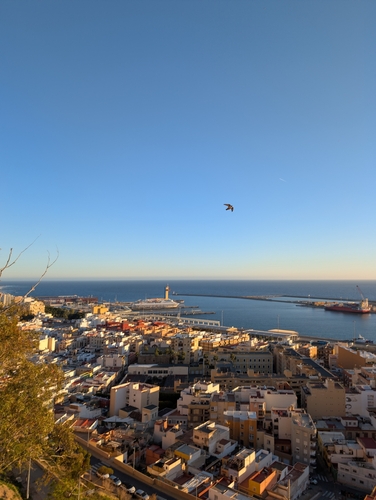 Eurasian Crag MartinPtyonoprogne rupestrisThe Eurasian crag martin is 13–15 cm (5.1–5.9 in) long, with a 32–34.5 cm (12.6–13.6 in) wingspan, and weighs an average 23 g (0.81 oz).
Side by side: Eurasian Crag Martin vs Large Rock Martin · Dusky Crag Martin vs Large Rock Martin · Large Rock Martin vs Pale Crag Martin
Learn the Large Rock Martin in the BeakBrain App
Photo and call practice. Coming soon to iPhone and Android.
Play today's Daily BirdEvery photo and recording on this page is credited to its author under the licence shown. Spotted a problem with this page, or have a better photo? Contribute.