Learn what every symbol on the card means.Full credits and sources at beakbrain.com/symbols
 GrasslandScrapeSmall · 40 g


ID tip
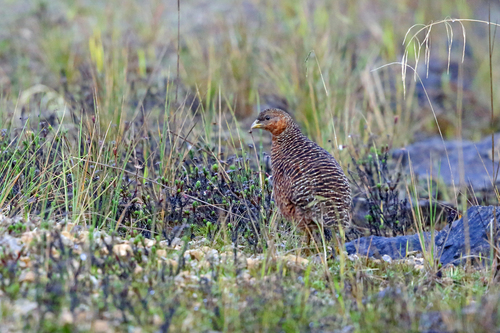
King quail is 12–15 cm long, with a wingspan of about 25 cm long, and weighing 20–57 g. Males are distinctive, with a dark brown back and wings, dark blue-grey flanks and neck, and dark red-brown underparts; the face is patterned with a black chin with a white band just below on the upper throat, and black and white stripes below the eyes. Females are much plainer rufous-brown all over except for a paler belly.
Text from Wikipedia, licensed CC BY-SA 4.0.
When to see the King Quail
One bar for each month, and every month is filled: this bird is recorded here in all twelve. The wide bar is February, the month with the most records.
Where to see the King Quail
The map shades 19 countries with regular records, and 3 more in a lighter tone where the bird turns up only as a stray. Everything unshaded has no records. Countries are listed below the map.
About the King Quail
The king quail, also known as the Asian blue quail, blue-breasted quail, Chinese painted quail, button quail, or Chung-Chi, is a very small, diminutive galliform of the tribe Coturnicini in the subfamily Phasianinae. They are the smallest member in this subfamily and the family Phasianidae, as well as being the smallest and lightest member of the order Galliformes. It is quite common in aviculture worldwide, where it is sometimes referred to as the "button quail", although it is not closely related to the family of birds called buttonquails. Its voice is a piping whistle, ti-yu or ti-ti-yu. It also gives sharp cheeps or a tir-tir-tir sound when flushed.
Text adapted from Wikipedia, licensed CC BY-SA 4.0.
Easily confused with
 Blue QuailSynoicus adansoniiThe blue quail is 14–16.5 cm (5.5–6.5 in) long and weighs 43–44 g (1.5–1.6 oz).
 Snow Mountain QuailSynoicus monorthonyxThe Snow Mountain quail, is a roughly 28-cm-long (11 in), dark brown quail of alpine grasslands.
 Brown QuailSynoicus ypsilophorusThe brown quail is a plump, stocky bird which can grow up to a length of 17 to 22 centimetres (6+1⁄2 to 8+1⁄2 in) and weight of 75 to 140 grams (2+3⁄4 to 5 oz).
Side by side: Brown Quail vs King Quail
Learn the King Quail in the BeakBrain App
Photo and call practice. Coming soon to iPhone and Android.
Play today's Daily BirdEvery photo and recording on this page is credited to its author under the licence shown. Spotted a problem with this page, or have a better photo? Contribute.