Learn what every symbol on the card means.Full credits and sources at beakbrain.com/symbols
 GrasslandScrapeSmall · 40 g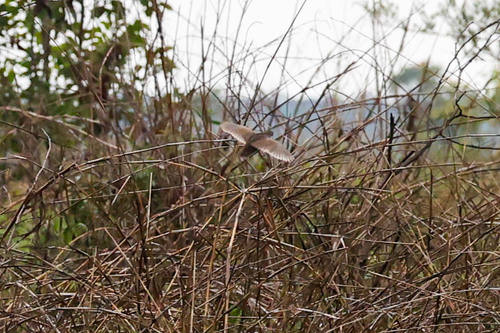


ID tip
The blue quail is 14–16.5 cm (5.5–6.5 in) long and weighs 43–44 g (1.5–1.6 oz). Its legs are yellow. The colour of the eyes varies from brown in the juvenile to red in the breeding male. The species is sexually dimorphic. The male's plumage is mostly dark slaty-blue, with rufous patches on its wings. The male has a black beak, a brown head, and a black and white throat. There is a white patch on its breast. Its flight feathers are brown. The forehead, sides of the head and neck, and flanks of the female are orange-buff. Its crown is brown, with black mottles. The female's beak is brownish.
Text from Wikipedia, licensed CC BY-SA 4.0.
When to see the Blue Quail
One bar for each month. Filled bars are the 11 months with records; pale bars are months with none. The wide bar is December, the month with the most records.
Where to see the Blue Quail
The map shades 9 countries with regular records, and 3 more in a lighter tone where the bird turns up only as a stray. Everything unshaded has no records. Countries are listed below the map.
Recorded as a rare visitor in South Africa, Congo - Kinshasa, Tanzania.
About the Blue Quail
The blue quail or African blue quail is a species of bird in the family Phasianidae found in sub-Saharan Africa.
Text adapted from Wikipedia, licensed CC BY-SA 4.0.
Easily confused with
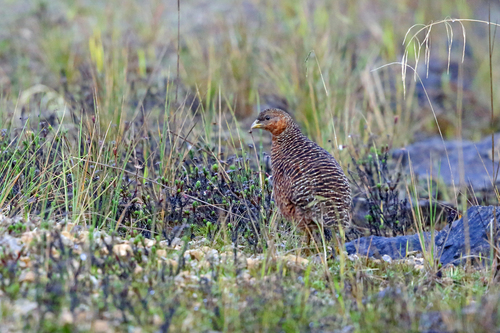 Snow Mountain QuailSynoicus monorthonyxThe Snow Mountain quail, is a roughly 28-cm-long (11 in), dark brown quail of alpine grasslands.
 King QuailSynoicus chinensisKing quail is 12–15 cm long, with a wingspan of about 25 cm long, and weighing 20–57 g.
 Brown QuailSynoicus ypsilophorusThe brown quail is a plump, stocky bird which can grow up to a length of 17 to 22 centimetres (6+1⁄2 to 8+1⁄2 in) and weight of 75 to 140 grams (2+3⁄4 to 5 oz).
Learn the Blue Quail in the BeakBrain App
Photo and call practice. Coming soon to iPhone and Android.
Play today's Daily BirdEvery photo and recording on this page is credited to its author under the licence shown. Spotted a problem with this page, or have a better photo? Contribute.