Learn what every symbol on the card means.Full credits and sources at beakbrain.com/symbols
 ForestScrapeLarge · 868 g

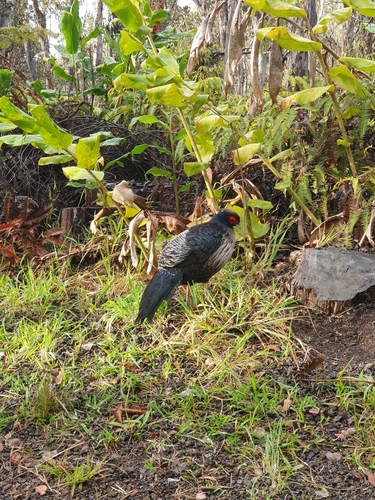
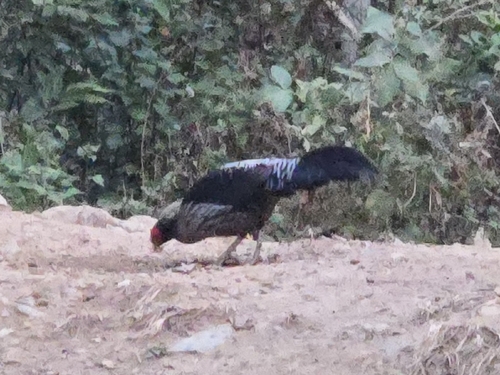
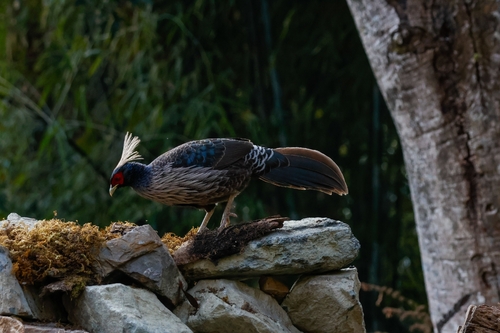
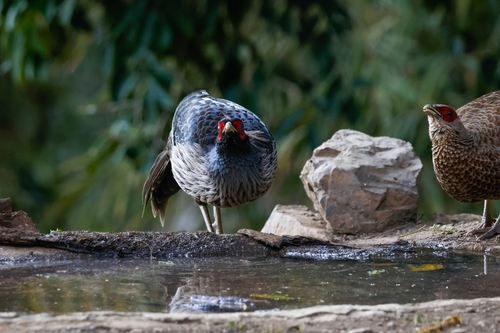
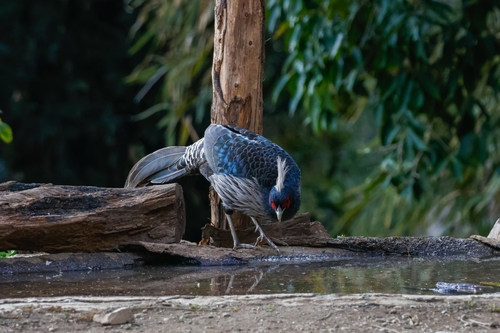
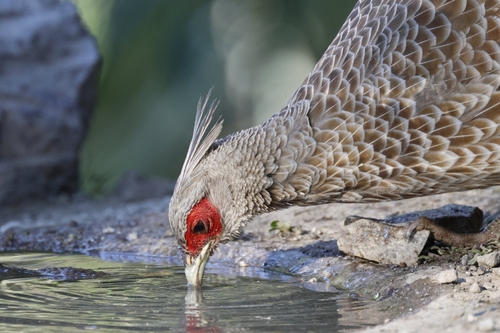
ID tip
Males have a total length of 63 to 74 cm (25 to 29 in) and females 50 to 60 cm (20 to 24 in). Very roughly, the subspecies can be divided into two main groups, with the first (subspecies L. l. hamiltoni, L. l. leucomelanos, L. l. melanota, L. l. moffitti, and L. l. lathami) being found in the western and central part of the species' range, while the second (L. l. williamsi, L. l. oatesi, L. l. lineata, and L. l. crawfurdi) is found in the eastern part.
Text from Wikipedia, licensed CC BY-SA 4.0.
When to see the Kalij Pheasant
One bar for each month. Filled bars are the 9 months with records; pale bars are months with none. The wide bar is March, the month with the most records.
Where to see the Kalij Pheasant
The map shades 9 countries with regular records. Everything unshaded has no records. Countries are listed below the map.
About the Kalij Pheasant
The kalij pheasant, or simply kalij, is a pheasant found in forests and thickets, especially in the Himalayan foothills, from Nepal, Pakistan to western Thailand. Males are rather variable depending on the subspecies involved, but all have at least partially glossy bluish-black plumage, while females are overall brownish. Both sexes have a bare red face and greyish legs. It is generally widespread, though three of its eastern subspecies are considered threatened and L. l. moffitti is virtually unknown in the wild.
Text adapted from Wikipedia, licensed CC BY-SA 4.0.
Easily confused with
 Swinhoe's PheasantLophura swinhoiiThe male Swinhoe's pheasant can grow up to 79 cm.
 Silver PheasantLophura nycthemeraThis is a relatively large pheasant, with males of the largest subspecies having a total length of 120 to 125 cm (47 to 49 in), including a tail up to 75 cm (30 in), while the males of the smallest subspecies barely reach 70 cm (28 in) in total length, including a tail around 30 cm (12 in).
 Bornean Crested FirebackLophura ignitaThe Bornean crested fireback maintains a similar body plan to most other species in Galliformes (heavy bodied ground-dwellers).
Side by side: Kalij Pheasant vs Spruce Grouse · Kalij Pheasant vs Swinhoe's Pheasant · Kalij Pheasant vs Silver Pheasant
Learn the Kalij Pheasant in the BeakBrain App
Photo and call practice. Coming soon to iPhone and Android.
Play today's Daily BirdEvery photo and recording on this page is credited to its author under the licence shown. Spotted a problem with this page, or have a better photo? Contribute.