Learn what every symbol on the card means.Full credits and sources at beakbrain.com/symbols
 ShrublandScrapeMedium · 121 g
ID tip
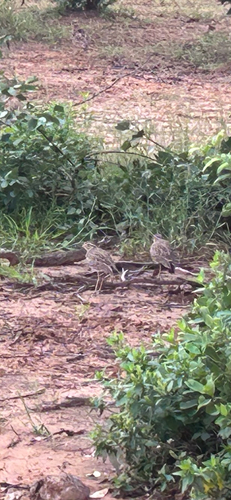
It is an unmistakable compact courser, with two brown breast-bands. It has a yellow base to the black bill, a blackish crown, broad buff supercilium, and an orange-chestnut throat patch. A narrow white crown stripe runs on top of the head. In-flight it shows a mostly black tail and a prominent white wing bar. It is crepuscular and vocal at dawn and dusk with a series of staccato Twick-too...Twick-too... Twick-too or yak-wak.. yak-wak calls. The notes are repeated at the rate of about 1 per second and uttered 2 to 16 times and several birds in the vicinity may join in the calling.
Text from Wikipedia, licensed CC BY-SA 4.0.
When to see the Jerdon's Courser
One bar for each month. Filled bars are the 5 months with records; pale bars are months with none. The wide bar is September, the month with the most records.
About the Jerdon's Courser
Jerdon's courser is a nocturnal bird belonging to the pratincole and courser family Glareolidae endemic to India. The bird was discovered by the surgeon-naturalist Thomas C. Jerdon in 1848 but not seen again until its rediscovery in 1986.
Text adapted from Wikipedia, licensed CC BY-SA 4.0.
Easily confused with

Learn the Jerdon's Courser in the BeakBrain App
Photo and call practice. Coming soon to iPhone and Android.
Play today's Daily BirdEvery photo and recording on this page is credited to its author under the licence shown. Spotted a problem with this page, or have a better photo? Contribute.