Learn what every symbol on the card means.Full credits and sources at beakbrain.com/symbols
 WoodlandScrapeMedium · 150 g


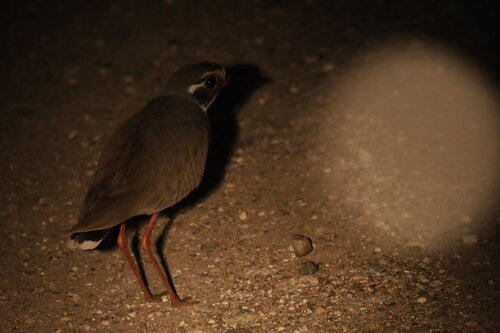

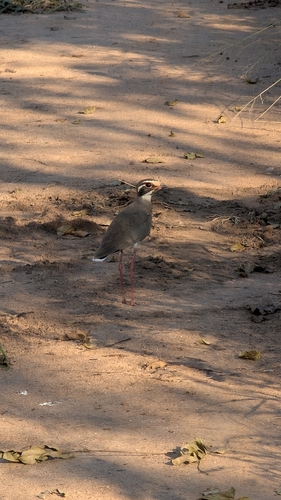

ID tip
The bronze-winged courser is a species of small wading birds with long legs and short wings. The bronze-winged courser is the largest of the coursers, with a body length of 25-29 centimeters, a wingspan up to 58 centimeters, and body weight between 91 and 220 grams. Voice: The bronze-winged courser can be heard by its calls at night, but is otherwise a quiet species.
Text from Wikipedia, licensed CC BY-SA 4.0.
When to see the Bronze-winged Courser
One bar for each month. Filled bars are the 10 months with records; pale bars are months with none. The wide bar is February, the month with the most records.
Where to see the Bronze-winged Courser
The map shades 22 countries with regular records, and 2 more in a lighter tone where the bird turns up only as a stray. Everything unshaded has no records. Countries are listed below the map.
Recorded as a rare visitor in Ghana, Central African Republic.
About the Bronze-winged Courser
The bronze-winged courser or violet-tipped courser is a species of bird in the family Glareolidae. This species is named for its characteristic bronze-tipped feathers that are visible during flight. It is found living throughout Sub-Saharan Africa, inhabiting semi-arid savannas and woodlands. This is a nocturnal species which mainly feeds on ground-dwelling insects. Bronze-winged coursers are typically solitary, only forming monogamous pairs for breeding. A female may produce 2-3 eggs per clutch, and the chicks receive parental care from both sexes when young. The bronze-winged courser is considered of Least Concern for conservation status, and is thought to be a very stable species.
Text adapted from Wikipedia, licensed CC BY-SA 4.0.
Easily confused with
Learn the Bronze-winged Courser in the BeakBrain App
Photo and call practice. Coming soon to iPhone and Android.
Play today's Daily BirdEvery photo and recording on this page is credited to its author under the licence shown. Spotted a problem with this page, or have a better photo? Contribute.