Learn what every symbol on the card means.Full credits and sources at beakbrain.com/symbols
 GrasslandPlatform nestHuge · 6.0 kg


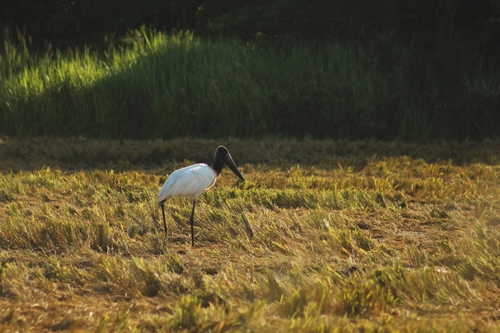
ID tip
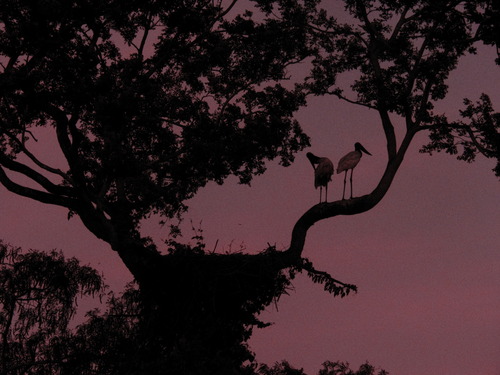
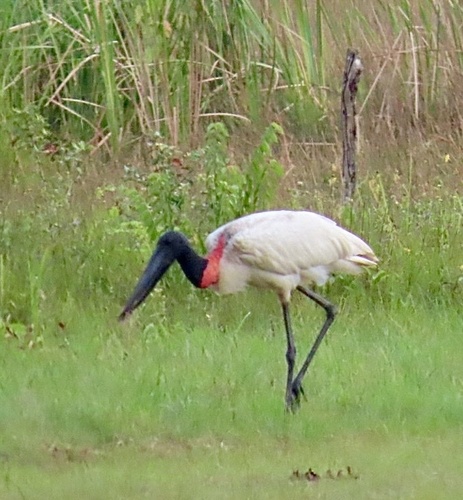
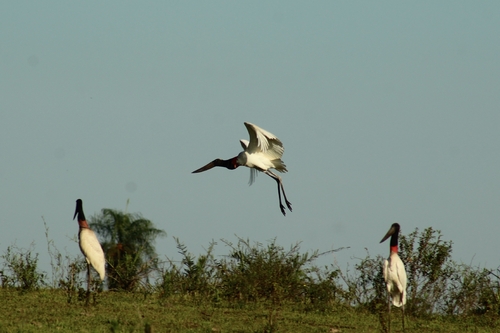
The jabiru is the tallest flying bird found in South America and Central America, often standing nearly the same height as the flightless and thus much heavier greater rhea. For the continent, it also has the second largest wingspan, after the Andean condor (that is, excluding the great albatross occasionally found off the coast of southern South America). The adult jabiru is 120–140 cm (47–55 in) long, 2.3–2.8 m (7.5–9.2 ft) across the wings, and can weigh 4.3–9 kg (9.5–19.8 lb). Sexual dimorphism is high, possibly the highest of any stork, with males being about 25% larger than females.
Text from Wikipedia, licensed CC BY-SA 4.0.
When to see the Jabiru
One bar for each month, and every month is filled: this bird is recorded here in all twelve. The wide bar is August, the month with the most records.
Where to see the Jabiru
The map shades 21 countries with regular records, and 2 more in a lighter tone where the bird turns up only as a stray. Everything unshaded has no records. Countries are listed below the map.
Recorded as a rare visitor in United States, Ecuador.
About the Jabiru
The jabiru is a large stork found in the Americas from Mexico to Argentina, except west of the Andes. It sometimes wanders into the United States, usually in Texas, but has also been reported in Mississippi, Oklahoma and Louisiana. It is most common in the Pantanal region of Brazil and the Eastern Chaco region of Paraguay. It is the only member of the genus Jabiru. The name comes from the Tupi–Guaraní language and means "swollen neck".
Text adapted from Wikipedia, licensed CC BY-SA 4.0.
Easily confused with
 African OpenbillAnastomus lamelligerusThe African openbill is a stork measuring 80–94 cm (31–37 in) and weighing 1–1.3 kg (2.2–2.9 lb).
 Maguari StorkCiconia maguariVoice: Adults utter wheezing, hissing, disyllabic whistles during up-down greeting displays at the nests about every 1–1.5 seconds.
 Marabou StorkLeptoptilos crumeniferThe marabou stork is a massive bird: large specimens are thought to reach a height of 152 centimetres (5 feet) and a weight of 9 kg (20 lb).
Side by side: Jabiru vs Maguari Stork · Jabiru vs Marabou Stork · African Openbill vs Jabiru
Learn the Jabiru in the BeakBrain App
Photo and call practice. Coming soon to iPhone and Android.
Play today's Daily BirdEvery photo and recording on this page is credited to its author under the licence shown. Spotted a problem with this page, or have a better photo? Contribute.