Learn what every symbol on the card means.Full credits and sources at beakbrain.com/symbols
 ForestPlatform nestLarge · 515 g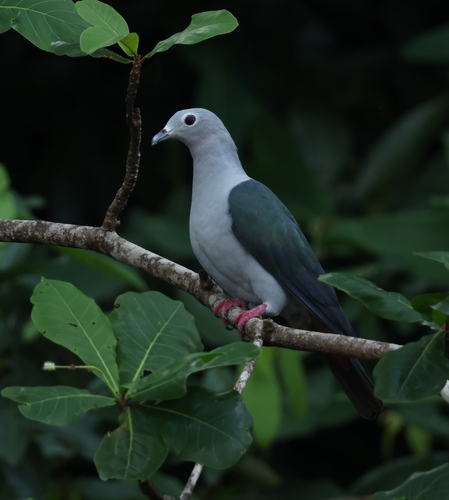
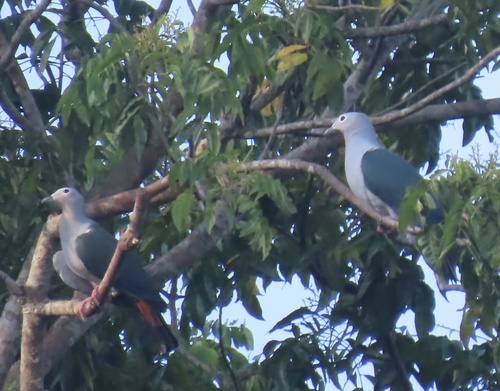
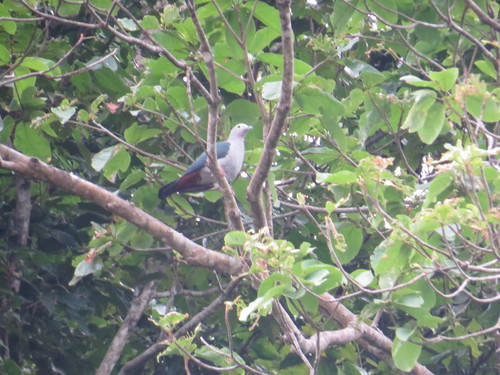
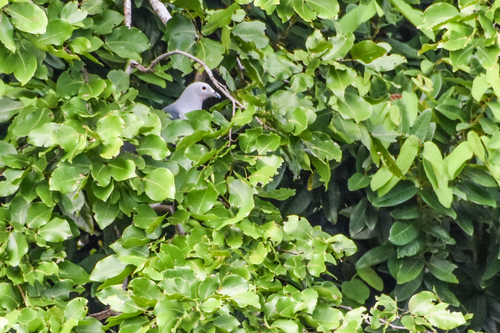
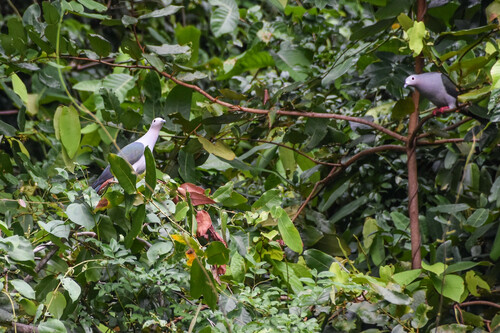


ID tip
The island imperial pigeon is about 39–45 cm (15–18 in) long and weighs 470–500 g (17–18 oz). The head and neck are pale grey, and there are white spectacles. The upperparts are glossy. The wing coverts and tertials are grey-green, and the primaries and secondaries are blackish. The back is grey-green. The uppertail is dark blue-green, and the undertail is chestnut. The throat is vinous, the breast is greyish-vinous, and the belly is greyish-fawn. The beak is slaty-blue, having a black tip. The eye is dark red or brownish, and the feet are red. The juvenile bird is duller and buffier.
Text from Wikipedia, licensed CC BY-SA 4.0.
When to see the Island Imperial Pigeon
One bar for each month. Filled bars are the 9 months with records; pale bars are months with none. The wide bar is September, the month with the most records.
Where to see the Island Imperial Pigeon
The map shades 2 countries with regular records. Everything unshaded has no records. Countries are listed below the map.
About the Island Imperial Pigeon
The island imperial pigeon or floury imperial pigeon is a species of bird in the family Columbidae. It is found in the Bismarck Archipelago and the Solomon Islands archipelago, living in primary and secondary forests and mangroves. The International Union for Conservation of Nature (IUCN) has assessed it as a least-concern species.
Text adapted from Wikipedia, licensed CC BY-SA 4.0.
Easily confused with
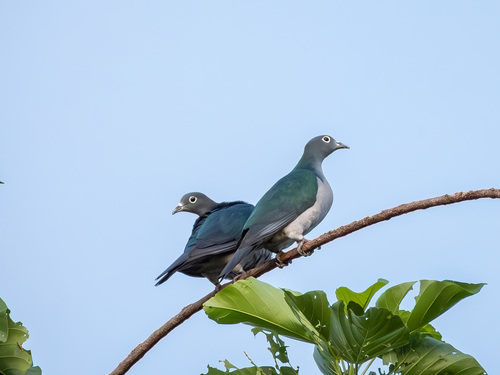 Spectacled Imperial PigeonDucula perspicillataThe spectacled imperial pigeon is a species of bird in the family Columbidae.
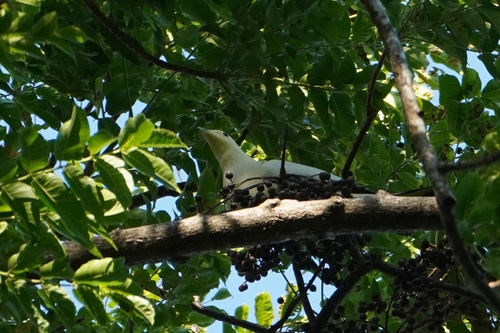 Silver-tipped Imperial PigeonDucula luctuosaIt has sometimes been considered a subspecies of the pied imperial pigeon, but has a yellowish tip to the bill, black spotting near the vent, and silvery-grey remiges.
 White-bellied Imperial PigeonDucula forsteniThe white-bellied imperial pigeon is a very large, boldly marked pigeon with a long tail, measuring 42.5–51.5 cm (16.7–20.3 in) long and weighing 510 g (18 oz) on average.
Learn the Island Imperial Pigeon in the BeakBrain App
Photo and call practice. Coming soon to iPhone and Android.
Play today's Daily BirdEvery photo and recording on this page is credited to its author under the licence shown. Spotted a problem with this page, or have a better photo? Contribute.