Learn what every symbol on the card means.Full credits and sources at beakbrain.com/symbols
 ShrublandCup nestTiny · 15 g


What the Indigo Bunting sounds like


ID tip
The indigo bunting is a smallish songbird, around the size of a small sparrow. It measures 11.5–15 cm (4.5–5.9 in) long, with a wingspan of 18–23 cm (7.1–9.1 in). Body mass averages 14.5 g (0.51 oz), with a reported range of 11.2–21.4 g (0.40–0.75 oz). During the breeding season, the adult male appears mostly a vibrant cerulean blue. Only the head is indigo. The wings and tail are black with cerulean blue edges. In fall and winter plumage, the male has brown edges to the blue body and head feathers, which overlap to make the bird appear mostly brown. Voice: The indigo bunting communicates through vocalizations and visual cues. A sharp chip! call is used by both sexes, and is used as an alarm call if a nest or chick is threatened. A high-pitched, buzzed zeeep is used as a contact call when the indigo bunting is in flight.
Text from Wikipedia, licensed CC BY-SA 4.0.
When to see the Indigo Bunting
One bar for each month. Filled bars are the 7 months with records; pale bars are months with none. The wide bar is May, the month with the most records.
Where to see the Indigo Bunting
The map shades 29 countries with regular records, and 7 more in a lighter tone where the bird turns up only as a stray. Everything unshaded has no records. Countries are listed below the map.
Recorded as a rare visitor in United Kingdom, Denmark, Norway, Venezuela, Haiti, St. Kitts & Nevis, Sweden.
About the Indigo Bunting
The indigo bunting is a small seed-eating bird in the cardinal family, Cardinalidae. It is migratory, ranging from southern Canada to northern Florida during the breeding season, and from southern Florida to northern South America during the winter. It often migrates by night, using the stars to navigate. Its habitat is farmland, brush areas, and open woodland. The indigo bunting is closely related to the lazuli bunting and interbreeds with the species where their ranges overlap.
Text adapted from Wikipedia, licensed CC BY-SA 4.0.
Easily confused with
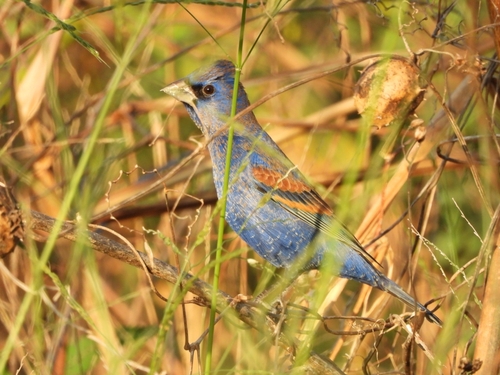 Blue GrosbeakPasserina caeruleaThe male blue grosbeak is deep blue, with both black and brown on its wings.
 Lazuli BuntingPasserina amoenaMeasurements:
Length: 5.1–5.9 in (13–15 cm)
Weight: 0.5–0.6 oz (13–18 g)
Wingspan: 8.7 in (22 cm)
The male is easily recognized by its bright blue head and back (lighter than the closely related indigo bunting), its conspicuous white wingbars, and its light rusty breast and white belly.
Lazuli BuntingPasserina amoenaMeasurements:
Length: 5.1–5.9 in (13–15 cm)
Weight: 0.5–0.6 oz (13–18 g)
Wingspan: 8.7 in (22 cm)
The male is easily recognized by its bright blue head and back (lighter than the closely related indigo bunting), its conspicuous white wingbars, and its light rusty breast and white belly.
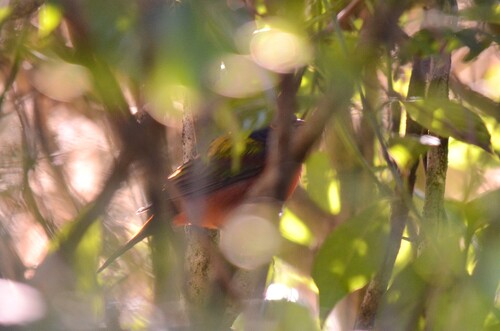 Painted BuntingPasserina cirisThe male painted bunting is often described as the most beautiful bird in North America and as such has been nicknamed nonpareil, or "without equal".
Side by side: Blue Grosbeak vs Indigo Bunting · Indigo Bunting vs Lazuli Bunting · Indigo Bunting vs Painted Bunting
Learn the Indigo Bunting in the BeakBrain App
Photo and call practice. Coming soon to iPhone and Android.
Play today's Daily BirdEvery photo and recording on this page is credited to its author under the licence shown. Spotted a problem with this page, or have a better photo? Contribute.