Learn what every symbol on the card means.Full credits and sources at beakbrain.com/symbols
 ForestDomed nestSmall · 56 g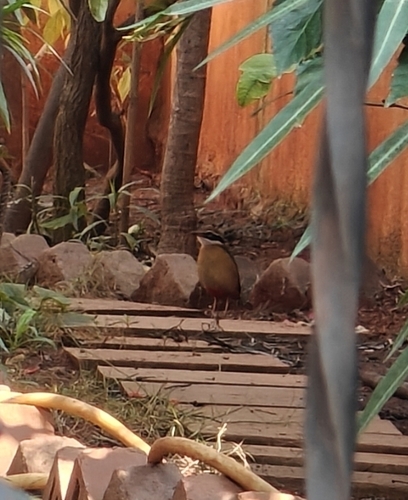

What the Indian Pitta sounds like

ID tip
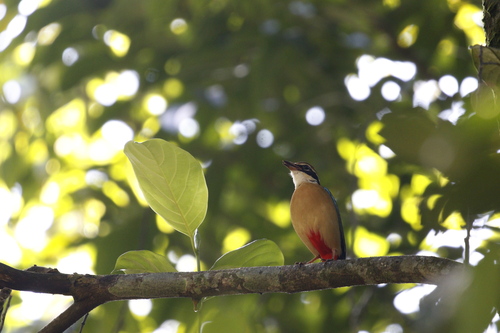
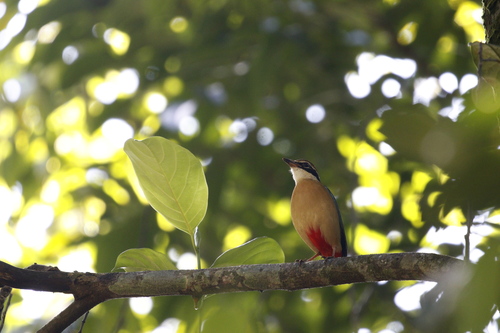
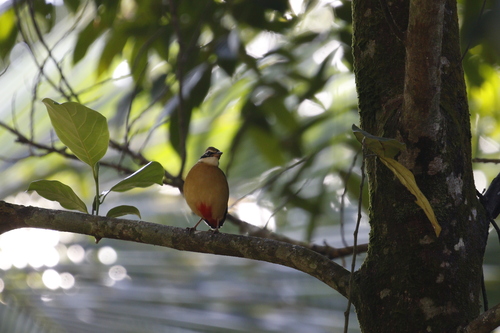
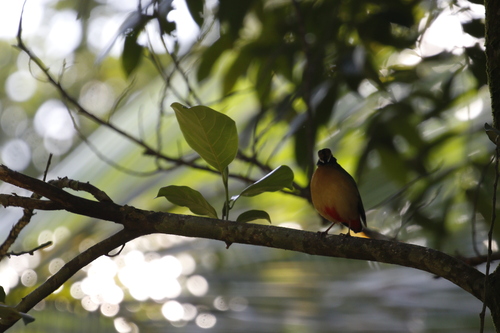
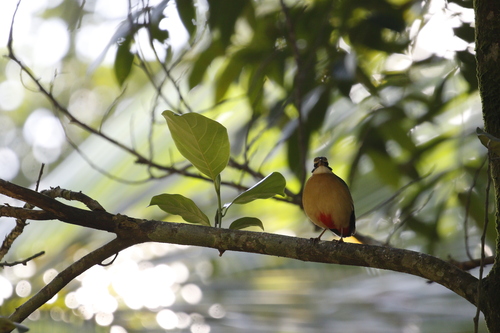
The Indian pitta is a small stubby-tailed bird that is mostly seen on the floor of forests or under dense undergrowth, foraging on insects in leaf litter. It has long, strong legs, a very short tail and stout bill, with a buff-coloured crown stripe, black coronal stripes, a thick black eye stripe and white throat and neck. The upper parts are green, with a blue tail, the underparts buff, with bright red on the lower belly and vent. The bird hops on the ground to forage and has been known to get trapped in ground traps meant for small mammals.
Text from Wikipedia, licensed CC BY-SA 4.0.
When to see the Indian Pitta
One bar for each month. Filled bars are the 10 months with records; pale bars are months with none. The wide bar is June, the month with the most records.
Where to see the Indian Pitta
The map shades 5 countries with regular records, and 1 more in a lighter tone where the bird turns up only as a stray. Everything unshaded has no records. Countries are listed below the map.
Recorded as a rare visitor in Bhutan.
About the Indian Pitta
The Indian pitta also known as Navrang, is a passerine bird native to the Indian subcontinent. It inhabits scrub jungle, deciduous and dense evergreen forest. It breeds in the forests of the Himalayas, hills of central and western India, and migrates to other parts of the peninsula in winter. Although very colourful, it is usually shy and hidden in the undergrowth where it picks insects on the forest floor. It has a distinctive two note whistling call which is heard at dawn and dusk. It is listed as least concern on the IUCN Red List as the population is considered large.
Text adapted from Wikipedia, licensed CC BY-SA 4.0.
Easily confused with
 Noisy PittaPitta versicolorThe noisy pitta is 19 to 21 cm (7.5–8.3 in) long.
 Western Hooded PittaPitta sordidaThe western hooded pitta is a passerine bird in the family Pittidae.
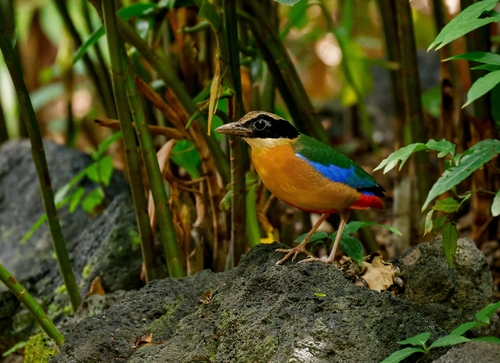 Blue-winged PittaPitta moluccensisMeasuring 180 to 205 mm (7.1–8.1 in) in length, the blue-winged pitta has a black head with a buff-coloured supercilium, white chin and buff underparts.
Side by side: Indian Pitta vs Noisy Pitta · Blue-winged Pitta vs Indian Pitta
Learn the Indian Pitta in the BeakBrain App
Photo and call practice. Coming soon to iPhone and Android.
Play today's Daily BirdEvery photo and recording on this page is credited to its author under the licence shown. Spotted a problem with this page, or have a better photo? Contribute.