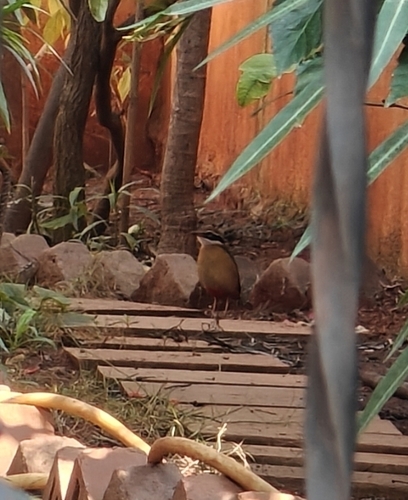
Indian Pitta
Pitta brachyura
The Indian pitta is a small stubby-tailed bird that is mostly seen on the floor of forests or under dense undergrowth, foraging on insects in leaf litter. It has long, strong legs, a very short tail and stout bill, with a buff-coloured crown stripe, black coronal stripes, a thick black eye stripe and white throat and neck. The upper parts are green, with a blue tail, the underparts buff, with bright red on the lower belly and vent. The bird hops on the ground to forage and has been known to get trapped in ground traps meant for small mammals.
ID text from Wikipedia, CC BY-SA 4.0


Noisy Pitta
Pitta versicolor
The noisy pitta is 19 to 21 cm (7.5–8.3 in) long. Males weigh 70–112 g (2.5–4.0 oz) and females 70–128 g (2.5–4.5 oz). It is a colourful bird. It has a black head and nape of neck with a chestnut crown. The wings are green with a turquoise front edge and the back is also green. The throat, breast and belly are lemon yellow. The tail is black and the under-tail coverts are orange-red. Juvenile birds resembled adults but are duller, with olive green on the wings and the buffy breast washed with grey, as is the throat and chin. Voice: Noisy pittas call most frequently in the morning with a secondary peak in calling around midday. Calling declines in the afternoon before spiking again at dusk. They also call at night. Seasonally, they call most frequently in the breeding season, with almost no calling between March and August.
ID text from Wikipedia, CC BY-SA 4.0
Learn this pair in the BeakBrain App
Photo and call practice. Coming soon to iPhone and Android.
Play today's Daily BirdPhotos and recordings are credited to their authors under the licence shown. Full profiles: Indian Pitta and Noisy Pitta.