Learn what every symbol on the card means.Full credits and sources at beakbrain.com/symbols
 GrasslandScrapeMedium · 94 g


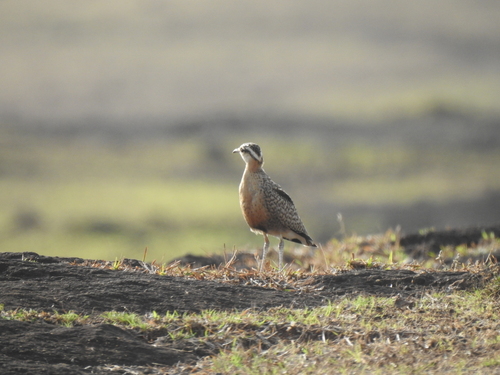
ID tip
This courser is widespread in South Asia and overlaps with some other species such as the similar looking cream-coloured courser. This species is however brighter coloured than the cream-coloured courser and has a broader black eye-stripe that begins at the base of the beak. The crown is chestnut and the breast is rufous. The nape has a dark black patch where the long longer feathers forming the white stripe meet. In flight, the rump appears white and the wing tip is not as contrastingly black as in the cream-coloured courser. The sexes are alike.
Text from Wikipedia, licensed CC BY-SA 4.0.
When to see the Indian Courser
One bar for each month, and every month is filled: this bird is recorded here in all twelve. The wide bar is February, the month with the most records.
Where to see the Indian Courser
The map shades 4 countries with regular records. Everything unshaded has no records. Countries are listed below the map.
About the Indian Courser
The Indian courser is a species of courser found in mainland South Asia, mainly in the plains bounded by the Ganges and Indus river system. Like other coursers, it is a ground bird that can be found in small groups as they forage for insects in dry open semi-desert country.
Text adapted from Wikipedia, licensed CC BY-SA 4.0.
Easily confused with
 Cream-colored CourserCursorius cursorCream-coloured coursers are variously cited as 19–21 cm, 21–24 cm, or 24–27 cm long; the wingspan is 51–57 cm.
 Temminck's CourserCursorius temminckiiTemminck's courser is a bird in the pratincole and courser family, Glareolidae.
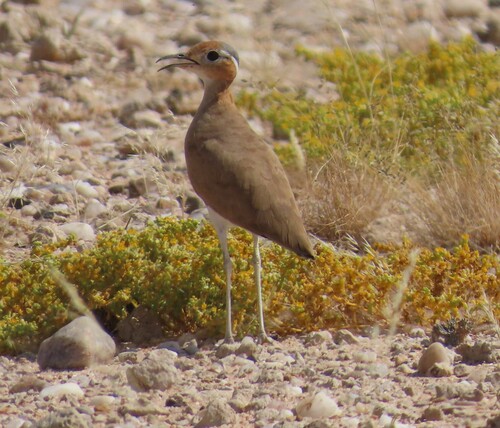 Burchell's CourserCursorius rufusBurchell's courser has a graceful figure and an upright posture.
Side by side: Cream-colored Courser vs Indian Courser
Learn the Indian Courser in the BeakBrain App
Photo and call practice. Coming soon to iPhone and Android.
Play today's Daily BirdEvery photo and recording on this page is credited to its author under the licence shown. Spotted a problem with this page, or have a better photo? Contribute.