Learn what every symbol on the card means.Full credits and sources at beakbrain.com/symbols
 ShrublandScrapeMedium · 75 g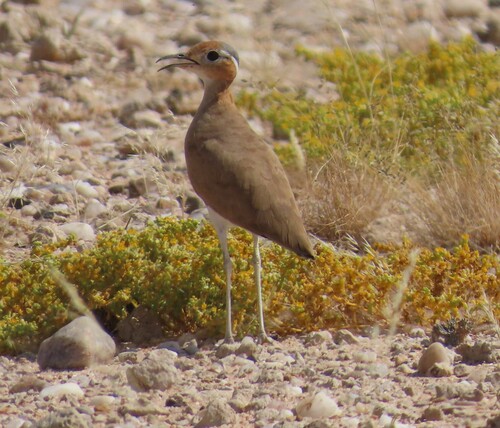
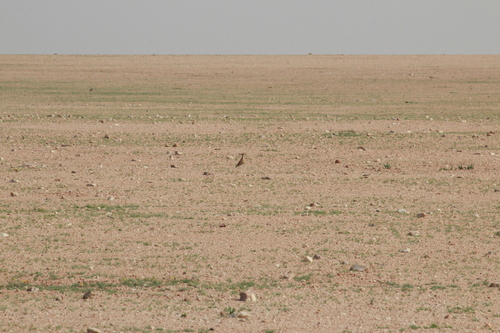
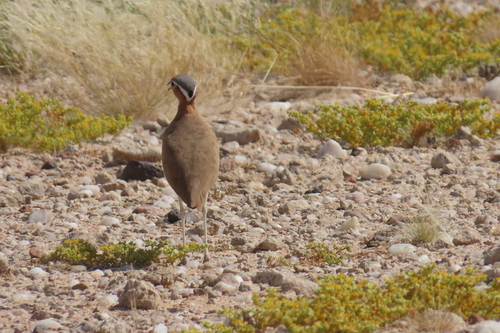
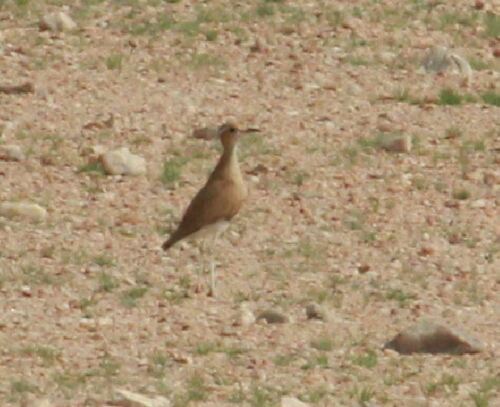
ID tip
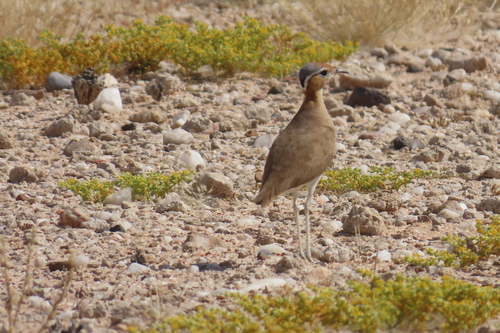
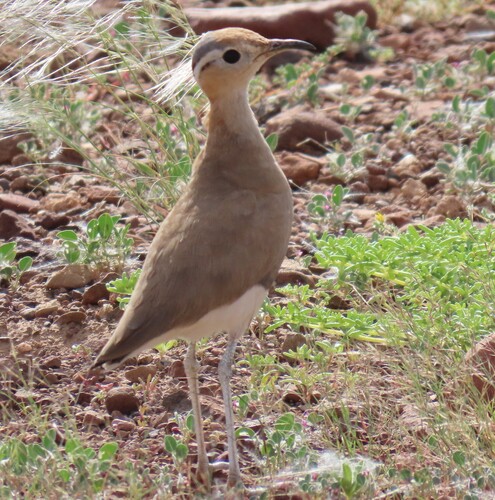
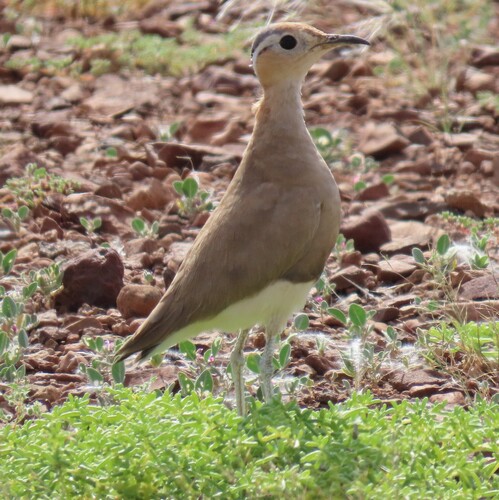
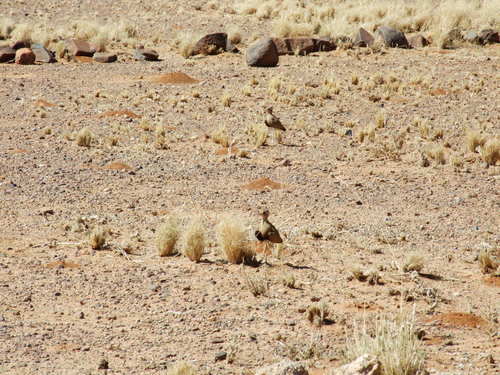
Burchell's courser has a graceful figure and an upright posture. It has a blue-grey hind crown which is mainly how it differs from the similar Temminck's courser. It also has a horizontal black band demarcating a white underbelly, and an overall pale rufous colour. Its face features white supercilia above black eye lines, all ending at the back of the neck to form a double V. In terms of feathers, its secondaries are mostly white with a black underwing and brown to grey coverts. Typical of coursers, its bill is long, arched down, and of a dark colour like its eyes. Voice: Burchell's courser often prefers to run rather than fly, and will most likely take to the air only when the disturbance is significant. Often referred to as inconspicuous, this bird is mostly quiet on the ground, but becomes vocal when flying, producing a loud flight call.
Text from Wikipedia, licensed CC BY-SA 4.0.
When to see the Burchell's Courser
One bar for each month, and every month is filled: this bird is recorded here in all twelve. The wide bar is October, the month with the most records.
Where to see the Burchell's Courser
The map shades 2 countries with regular records, and 2 more in a lighter tone where the bird turns up only as a stray. Everything unshaded has no records. Countries are listed below the map.
About the Burchell's Courser
Burchell's courser is a wader in the pratincole and courser family, Glareolidae. The name of this bird commemorates the English naturalist William John Burchell.
Text adapted from Wikipedia, licensed CC BY-SA 4.0.
Easily confused with
 Somali CourserCursorius somalensisThe Somali courser is a wader in the pratincole and courser family Glareolidae, native to eastern Africa in Eritrea, eastern Ethiopia, Somalia, extreme southeast South Sudan, and northern and eastern Kenya.
 Indian CourserCursorius coromandelicusThis courser is widespread in South Asia and overlaps with some other species such as the similar looking cream-coloured courser.
 Cream-colored CourserCursorius cursorCream-coloured coursers are variously cited as 19–21 cm, 21–24 cm, or 24–27 cm long; the wingspan is 51–57 cm.
Learn the Burchell's Courser in the BeakBrain App
Photo and call practice. Coming soon to iPhone and Android.
Play today's Daily BirdEvery photo and recording on this page is credited to its author under the licence shown. Spotted a problem with this page, or have a better photo? Contribute.