Learn what every symbol on the card means.Full credits and sources at beakbrain.com/symbols
 ForestPlatform nestHuge · 2.1 kg


ID tip
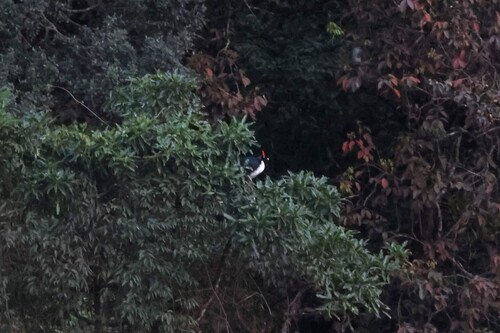
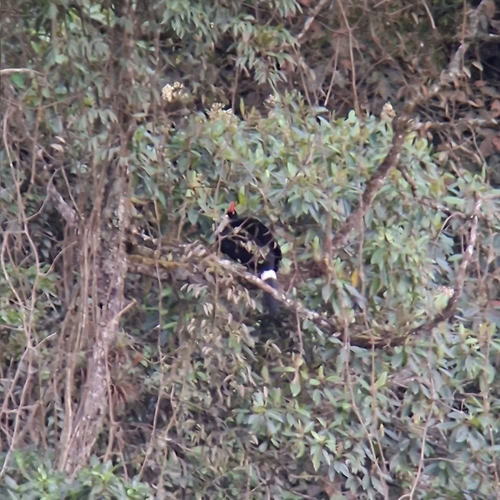
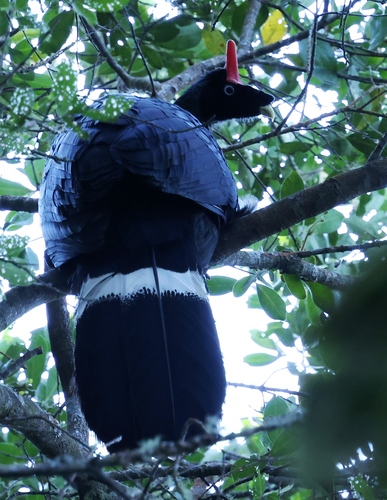
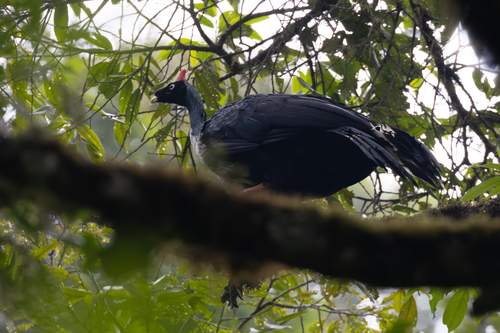
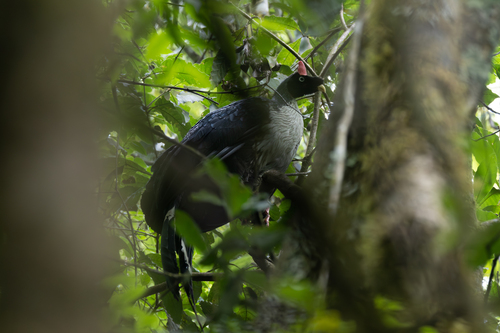
The horned guan is 75 to 85 cm (30 to 33 in) long. Its most distinctive feature is the tall, red, fleshy "horn" on its forehead. It has a small head, long strong legs, and a long broad tail. The sexes are alike in plumage but males have a taller horn and longer wings, tail, and legs than females. Adults have a glossy black head, neck, and upperparts with a bluish sheen. Their tail is black with a wide white band near its base. Their throat, breast, and upper belly are whitish with black flecks and their lower belly and flanks are brown. Voice: Male and female horned guans have very different vocalizations. Males have a repertoire of at least five calls and females have seven or eight. Female's calls are "guttural and louder compared to those of males". The male's main call is "a very deep, slow and soft 'mooing'...comprising seven notes, a single brief hum followed by six paired hums, i.e.
Text from Wikipedia, licensed CC BY-SA 4.0.
When to see the Horned Guan
One bar for each month. Filled bars are the 8 months with records; pale bars are months with none. The wide bar is March, the month with the most records.
Where to see the Horned Guan
The map shades 2 countries with regular records. Everything unshaded has no records. Countries are listed below the map.
About the Horned Guan
The horned guan is an endangered species in an ancient group of birds of the family Cracidae, which are related to the Australasian megapodes or mound builders (Megapodiidae). It is found in Mexico, Guatemala, and possibly Honduras.
Text adapted from Wikipedia, licensed CC BY-SA 4.0.
Easily confused with
 Bearded GuanPenelope barbataThe bearded guan (Penelope barbata) is a small mostly brown bird that is about 55 cm large, and named for it red dewlap (or beard) While most of the bird is brown, it has dark grayish-brown upper parts and rear underparts as well as a silver crown and neck feathers.
 East Brazilian ChachalacaOrtalis araucuanThe East Brazilian chachalaca is about 50 cm (1.6 ft) long.
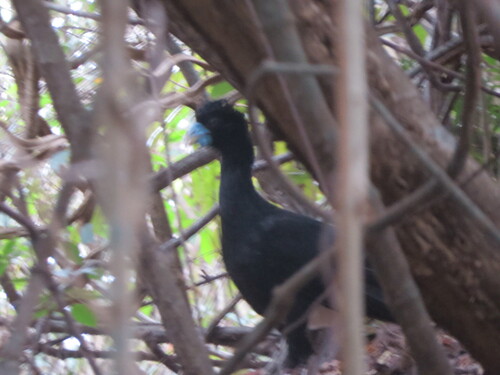 Blue-billed CurassowCrax albertiThe blue-billed curassow is 82.5 to 92.5 cm (2.7 to 3.0 ft) long and weighs 3.2 to 3.6 kg (7.1 to 7.9 lb).
Learn the Horned Guan in the BeakBrain App
Photo and call practice. Coming soon to iPhone and Android.
Play today's Daily BirdEvery photo and recording on this page is credited to its author under the licence shown. Spotted a problem with this page, or have a better photo? Contribute.