Learn what every symbol on the card means.Full credits and sources at beakbrain.com/symbols
 RockyCup nestTiny · 13 g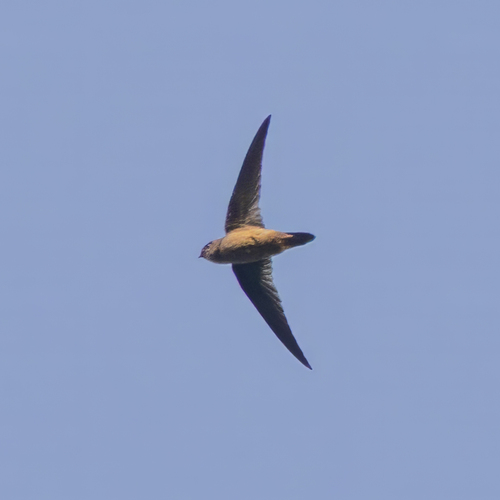
ID tip
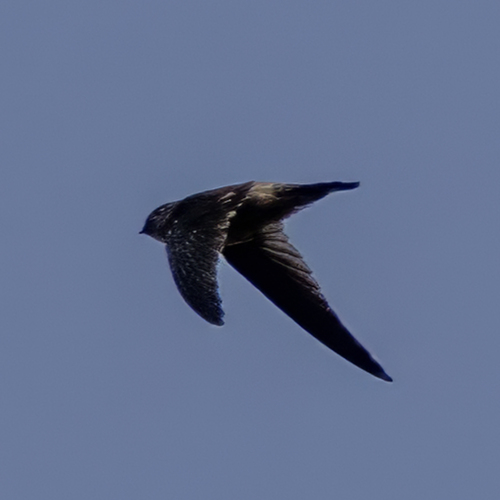
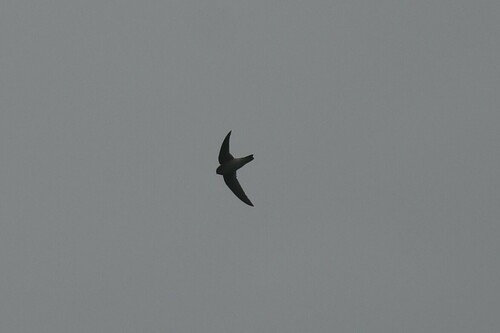
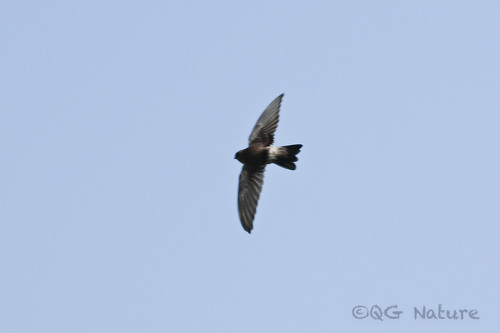
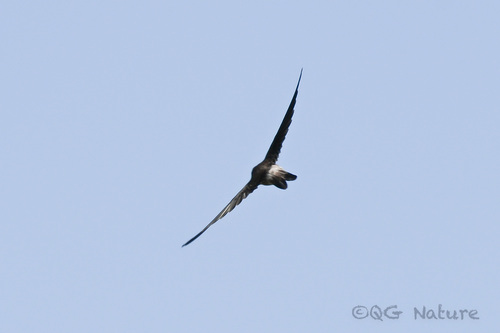
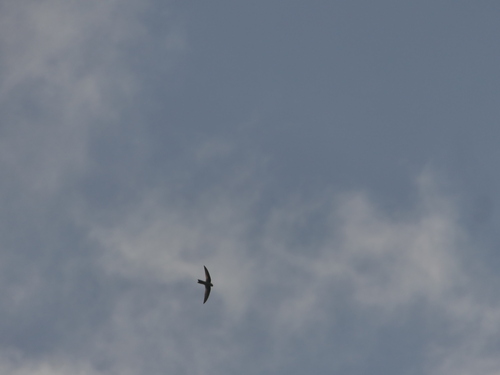
This 13–14 cm long swiftlet has swept-back wings that resemble a crescent or a boomerang. The body is slender, and the tail is forked. It is, in many respects, a typical swift, having narrow wings for fast flight, and a wide gape and small beak surrounded by bristles for catching insects in flight. Its legs are very short, preventing the bird from perching, but allowing it to cling to vertical surfaces. It is mainly grey-brown above and paler brown below. It has a pale grey rump and a pale patch above and behind the bill. The sexes are similar, but the juvenile has a less distinct rump.
Text from Wikipedia, licensed CC BY-SA 4.0.
When to see the Himalayan Swiftlet
One bar for each month. Filled bars are the 9 months with records; pale bars are months with none. The wide bar is February, the month with the most records.
Where to see the Himalayan Swiftlet
The map shades 13 countries with regular records, and 5 more in a lighter tone where the bird turns up only as a stray. Everything unshaded has no records. Countries are listed below the map.
Recorded as a rare visitor in Taiwan, South Korea, Singapore, Japan, Yemen.
About the Himalayan Swiftlet
The Himalayan swiftlet is a small swift. It is a common colonial breeder in the Himalayas and Southeast Asia. Some populations are migratory.
Text adapted from Wikipedia, licensed CC BY-SA 4.0.
Easily confused with
 Uniform SwiftletAerodramus vanikorensisThe uniform swiftlet is a gregarious, medium-sized swiftlet with a shallowly forked tail.
 Australian SwiftletAerodramus terraereginaeIt is 11–12 centimetres (4.3–4.7 in) long with a wing length of 107–118.2 millimetres (4.21–4.65 in) and a weight of 10.5–12.5 grams (0.37–0.44 oz).
 White-rumped SwiftletAerodramus spodiopygiusThe white-rumped swiftlet is a species of swift in the family Apodidae.
Side by side: Edible-nest Swiftlet vs Himalayan Swiftlet · Australian Swiftlet vs Himalayan Swiftlet · Himalayan Swiftlet vs Uniform Swiftlet
Learn the Himalayan Swiftlet in the BeakBrain App
Photo and call practice. Coming soon to iPhone and Android.
Play today's Daily BirdEvery photo and recording on this page is credited to its author under the licence shown. Spotted a problem with this page, or have a better photo? Contribute.