
Australian Swiftlet
Aerodramus terraereginae
It is 11–12 centimetres (4.3–4.7 in) long with a wing length of 107–118.2 millimetres (4.21–4.65 in) and a weight of 10.5–12.5 grams (0.37–0.44 oz). The upperparts are dark grey-brown while the underparts are a uniform greyish. There are pale feathers on the forehead and lores. The rump is normally pale greyish but can occasionally be darker. The tail is slightly forked. The form chillagoensis is smaller and paler with a weight of around 9.39 grams (0.33 oz). It has a high-pitched flight call. In its breeding caves, it utters a metallic clicking call, used for echolocation.
ID text from Wikipedia, CC BY-SA 4.0
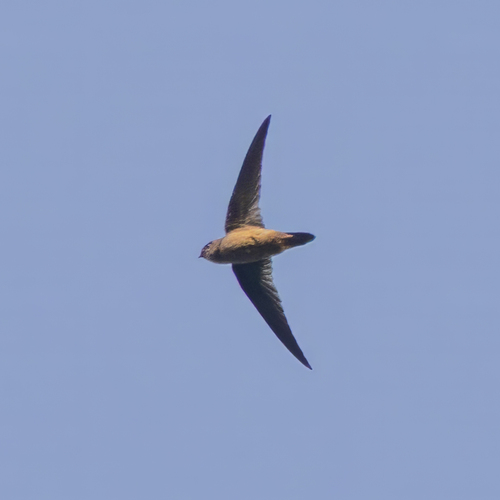
Himalayan Swiftlet
Aerodramus brevirostris
This 13–14 cm long swiftlet has swept-back wings that resemble a crescent or a boomerang. The body is slender, and the tail is forked. It is, in many respects, a typical swift, having narrow wings for fast flight, and a wide gape and small beak surrounded by bristles for catching insects in flight. Its legs are very short, preventing the bird from perching, but allowing it to cling to vertical surfaces. It is mainly grey-brown above and paler brown below. It has a pale grey rump and a pale patch above and behind the bill. The sexes are similar, but the juvenile has a less distinct rump.
ID text from Wikipedia, CC BY-SA 4.0
Learn this pair in the BeakBrain App
Photo and call practice. Coming soon to iPhone and Android.
Play today's Daily BirdPhotos and recordings are credited to their authors under the licence shown. Full profiles: Australian Swiftlet and Himalayan Swiftlet.