Learn what every symbol on the card means.Full credits and sources at beakbrain.com/symbols
 GrasslandPlatform nestLarge · 393 g


What the Hen Harrier sounds like

ID tip
The hen harrier is 41–52 cm (16–20 in) long with a 97–122 cm (38–48 in) wingspan. It resembles other harriers in having distinct male and female plumages. The sexes also differ in weight, with males weighing 290 to 400 g (10 to 14 oz), with an average of 350 g (12 oz), and females weighing 390 to 750 g (14 to 26 oz), with an average of 530 g (19 oz). Among standard measurements, the wing chord is 32.8 to 40.6 cm (12.9 to 16.0 in), the tail is 19.3 to 25.8 cm (7.6 to 10.2 in) and the tarsus is 7.1 to 8.9 cm (2.8 to 3.5 in). It is relatively long winged and long tailed.
Text from Wikipedia, licensed CC BY-SA 4.0.
When to see the Hen Harrier
One bar for each month. Filled bars are the 10 months with records; pale bars are months with none. The wide bar is January, the month with the most records.
Where to see the Hen Harrier
The map shades 110 countries with regular records, and 5 more in a lighter tone where the bird turns up only as a stray. Everything unshaded has no records. Countries are listed below the map.
Recorded as a rare visitor in North Korea, Liechtenstein, St. Lucia, Cambodia, Singapore.
About the Hen Harrier
The hen harrier is a bird of prey. It breeds in open areas such as marshes and grasslands in Eurasia and is migratory, moving further south outside of the breeding season. Birds in milder regions, such as France and Great Britain, may be resident year-round, but the higher altitudes are largely deserted in winter. The species is sexually dimorphic; males are smaller and mostly grey and white with black wingtips, whereas females average larger and are predominantly brown and have buff underparts with brown barring. Both sexes have a white rump patch, although it is more noticeable on females and juveniles.
Text adapted from Wikipedia, licensed CC BY-SA 4.0.
Easily confused with
 Western Marsh HarrierCircus aeruginosusThe western marsh harrier is 48 to 56 cm (19 to 22 in) in length, has a wingspan of 115 to 130 cm (45 to 51 in) and a weight of 400 to 650 g (14 to 23 oz) in males and 550 to 800 g (19 to 28 oz) in females.
 Montagu's HarrierCircus pygargusSexual dimorphism is particularly apparent in the plumage of this species.
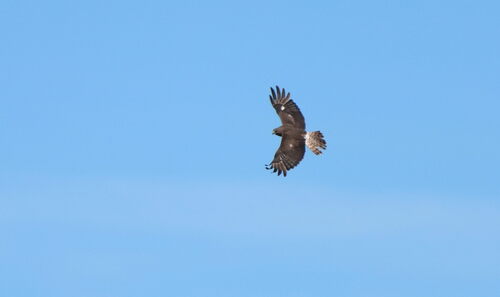 Swamp HarrierCircus approximansThe swamp harrier is largely dark brown, becoming lighter with age, and has a distinct white rump.
Side by side: Hen Harrier vs Western Marsh Harrier · Hen Harrier vs Montagu's Harrier · Hen Harrier vs Swamp Harrier
Learn the Hen Harrier in the BeakBrain App
Photo and call practice. Coming soon to iPhone and Android.
Play today's Daily BirdEvery photo and recording on this page is credited to its author under the licence shown. Spotted a problem with this page, or have a better photo? Contribute.