Learn what every symbol on the card means.Full credits and sources at beakbrain.com/symbols
 CoastalPlatform nestLarge · 500 g


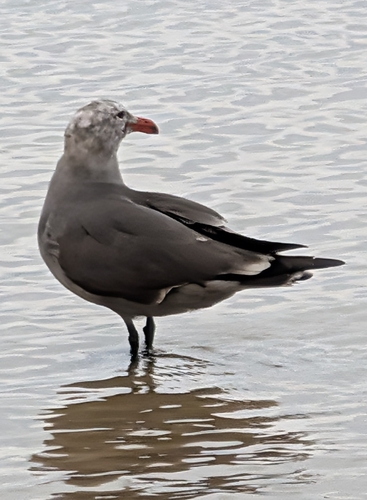
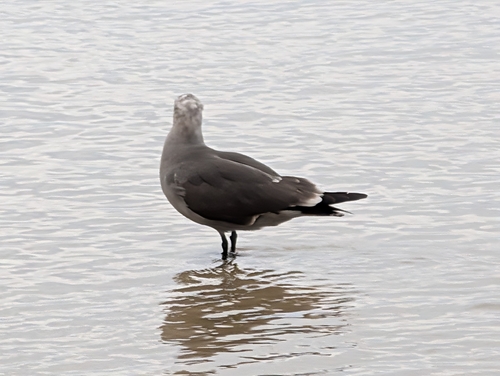
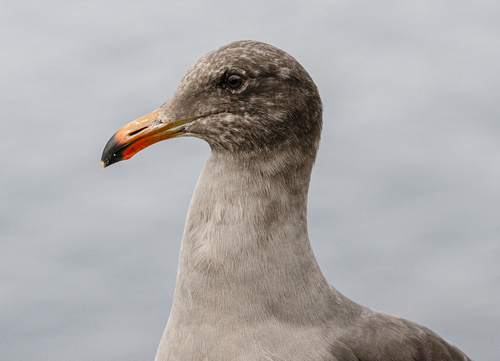

ID tip
This species looks distinctly different from other gulls. Adults have a medium gray body, blackish-gray wings and tail with white edges, and a red bill with a black tip. The head is dusky gray in non-breeding plumage and white in breeding plumage. Immatures resemble non-breeding adults but are darker and browner, and the bill is pink till the second winter. A few birds, no more than 1 in 200, have white primary coverts, which form a showy spot on the upper wing.
Text from Wikipedia, licensed CC BY-SA 4.0.
When to see the Heermann's Gull
One bar for each month. Filled bars are the 9 months with records; pale bars are months with none. The wide bar is September, the month with the most records.
Where to see the Heermann's Gull
The map shades 4 countries with regular records. Everything unshaded has no records. Countries are listed below the map.
About the Heermann's Gull
Heermann's gull is a gull resident in the United States, Mexico and extreme southwestern British Columbia, nearly all nesting on Isla Rasa in the Gulf of California. They are usually found near shores or well out to sea, very rarely inland. The species is named after Adolphus Lewis Heermann, nineteenth-century explorer and naturalist.
Text adapted from Wikipedia, licensed CC BY-SA 4.0.
Easily confused with
 Iceland GullLarus glaucoidesThe Iceland gull is a medium-sized gull, although relatively slender and light in weight.
 Glaucous GullLarus hyperboreusThis is a large and powerful gull, second-largest of all gull species and very pale in all plumage, with no black on either the wings or the tail.
 Short-billed GullLarus brachyrhynchusThe short-billed gull has a length 40–45 cm (16–18 in) and a wingspan 100–120 cm (39–47 in).
Side by side: Heermann's Gull vs Kelp Gull · Heermann's Gull vs Short-billed Gull · Heermann's Gull vs Iceland Gull · Glaucous Gull vs Heermann's Gull
Learn the Heermann's Gull in the BeakBrain App
Photo and call practice. Coming soon to iPhone and Android.
Play today's Daily BirdEvery photo and recording on this page is credited to its author under the licence shown. Spotted a problem with this page, or have a better photo? Contribute.