Learn what every symbol on the card means.Full credits and sources at beakbrain.com/symbols
 ForestPlatform nestLarge · 468 g


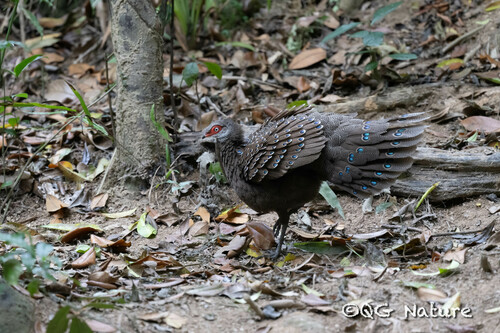
ID tip
The bird was long considered a subspecies of grey peacock-pheasant or Polyplectron bicalcaratum. The Hainan peacock-pheasant is smaller, and it possesses a short crest and ruff (Johnsgard 1986). It has red facial skin as opposed to grey in the yellow-orange facial skin of the grey peacock-pheasant. Beebe (1922) noted various plumage differences between the two and considered them separate species.
Text from Wikipedia, licensed CC BY-SA 4.0.
When to see the Hainan Peacock-Pheasant
One bar for each month. Filled bars are the 3 months with records; pale bars are months with none. The wide bar is March, the month with the most records.
Where to see the Hainan Peacock-Pheasant
The map shades 1 country with regular records. Everything unshaded has no records. Countries are listed below the map.
About the Hainan Peacock-Pheasant
The Hainan peacock-pheasant is an endangered bird that belongs to the pheasant family Phasianidae. This extremely rare species is endemic to the island of Hainan, China.
Text adapted from Wikipedia, licensed CC BY-SA 4.0.
Easily confused with
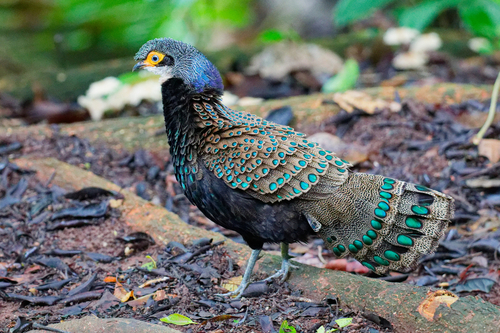 Bornean Peacock-PheasantPolyplectron schleiermacheriThe pheasant is up to 50 cm long, rufous brown and black spotted, with an elongated crest and nape feathers, black below and bare red skin around bluish iris eye.
Sumatran Peacock-PheasantPolyplectron chalcurumThe bronze-tailed peacock-pheasant is a small, up to 56 cm long, dark brown pheasant with dark grey legs, rather small head and long, narrow tail of sixteen feathers.
Bornean Peacock-PheasantPolyplectron schleiermacheriThe pheasant is up to 50 cm long, rufous brown and black spotted, with an elongated crest and nape feathers, black below and bare red skin around bluish iris eye.
Sumatran Peacock-PheasantPolyplectron chalcurumThe bronze-tailed peacock-pheasant is a small, up to 56 cm long, dark brown pheasant with dark grey legs, rather small head and long, narrow tail of sixteen feathers.
 Palawan Peacock-PheasantPolyplectron napoleonisThe adult male is the most peacock-like member of the genus Polyplectron in appearance.
Learn the Hainan Peacock-Pheasant in the BeakBrain App
Photo and call practice. Coming soon to iPhone and Android.
Play today's Daily BirdEvery photo and recording on this page is credited to its author under the licence shown. Spotted a problem with this page, or have a better photo? Contribute.