Learn what every symbol on the card means.Full credits and sources at beakbrain.com/symbols
 ForestLarge · 375 g


ID tip
The adult male is the most peacock-like member of the genus Polyplectron in appearance. It has an erectile crest and highly iridescent electric blue-violet, metallic green-turquoise dorsal plumage. Its breast and ventral regions are a velvety black. The flight feathers (rectrices) are wide, flat, and rigid; velvety black on the inner edges and an iridescent violet-blue-green on the outer edges. Their terminal edges are squared. The tail feathers are black with very fine golden-brown speckling.
Text from Wikipedia, licensed CC BY-SA 4.0.
When to see the Palawan Peacock-Pheasant
One bar for each month. Filled bars are the 9 months with records; pale bars are months with none. The wide bar is February, the month with the most records.
Where to see the Palawan Peacock-Pheasant
The map shades 1 country with regular records. Everything unshaded has no records. Countries are listed below the map.
About the Palawan Peacock-Pheasant
The Palawan peacock-pheasant is a medium-sized bird in the family Phasianidae endemic to the island of Palawan in the Philippines. The spectacular male has a black body with blue marks on the wings, a grayish, finely speckled back and tail with blue peacock "eyes," white marks on the face, and a red eye-ring. Females are mostly brown but with a white face. It is known as tandikan in the some local Palawano, Tagbanwa, and Batak languages of Palawan. It is featured prominently in the culture of the indigenous people of Palawan.
Text adapted from Wikipedia, licensed CC BY-SA 4.0.
Easily confused with
 Malayan Peacock-PheasantPolyplectron malacenseIt is one of the shortest-tailed peacock-pheasants.
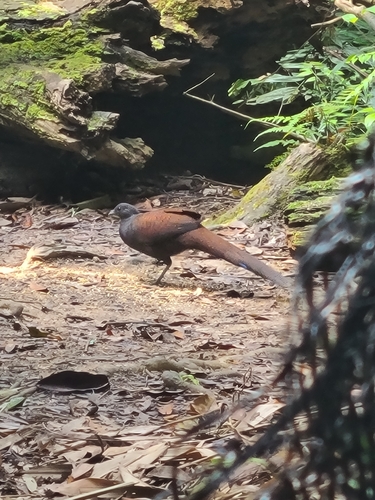 Mountain Peacock-PheasantPolyplectron inopinatumThe mountain peacock-pheasant, also known as Rothschild's peacock-pheasant or mirror pheasant, is a medium-sized, up to 65 cm long, blackish brown pheasant.
Learn the Palawan Peacock-Pheasant in the BeakBrain App
Photo and call practice. Coming soon to iPhone and Android.
Play today's Daily BirdEvery photo and recording on this page is credited to its author under the licence shown. Spotted a problem with this page, or have a better photo? Contribute.