Learn what every symbol on the card means.Full credits and sources at beakbrain.com/symbols
 ForestPlatform nestHuge · 3.1 kg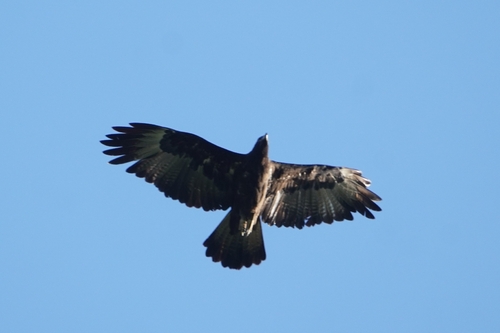
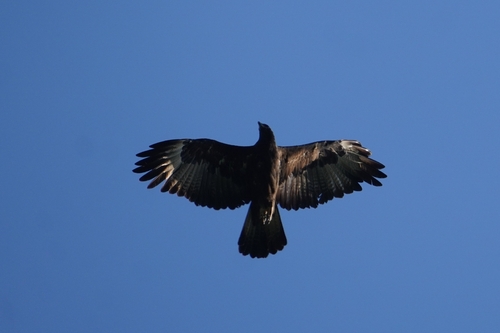
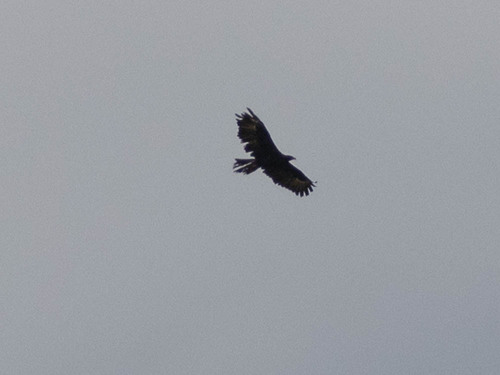
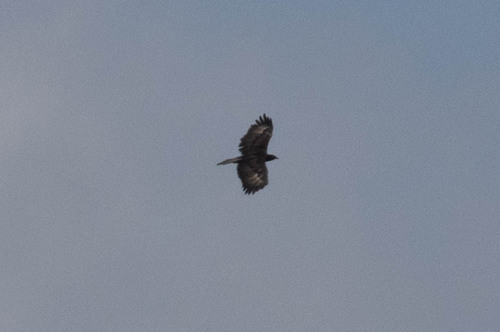
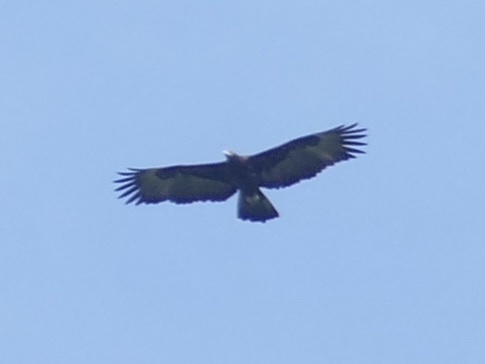

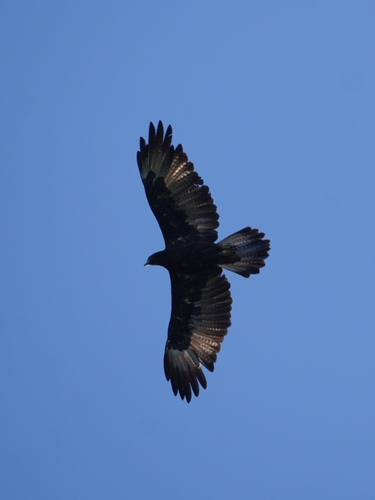
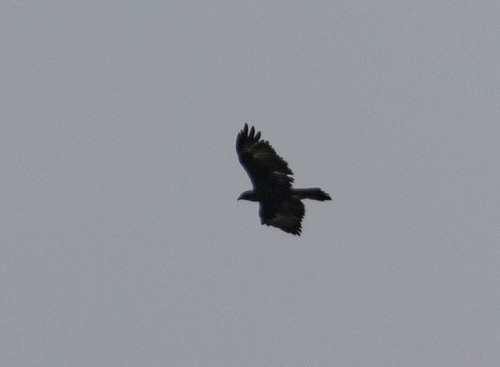
ID tip
This eagle is a fairly large species, though mid-sized as a member of the genus Aquila. It is mainly dark brown to black, with paler undersides to its flight feathers and a rounded tail. Its body length is 74–86 cm (29–34 in) with a wingspan of between 1.65 and 1.9 m (5 ft 5 in and 6 ft 3 in). Females are larger than males. One immature female weighed 3.06 kg (6.7 lb). Males are estimated to weigh about 2.21 kg (4.9 lb) in this species. Its wings are held level when gliding. It feeds on mammals (such as cuscuses), reptiles, fish, and birds.
Text from Wikipedia, licensed CC BY-SA 4.0.
When to see the Gurney's Eagle
One bar for each month. Filled bars are the 6 months with records; pale bars are months with none. The wide bar is July, the month with the most records.
Where to see the Gurney's Eagle
The map shades 2 countries with regular records, and 1 more in a lighter tone where the bird turns up only as a stray. Everything unshaded has no records. Countries are listed below the map.
Recorded as a rare visitor in Australia.
About the Gurney's Eagle
Gurney's eagle is a large eagle in the family Accipitridae. It is found in New Guinea and Wallacea, and is an occasional vagrant to Australia.
Text adapted from Wikipedia, licensed CC BY-SA 4.0.
Easily confused with
 Cassin's Hawk-EagleAquila africanaThe adult Cassin's hawk-eagle appears as a small eagle, with short rounded wings and a long rounded tail.
 African Hawk-EagleAquila spilogasterThe African hawk-eagle has a somewhat small head but one that protrudes quite well due its quite long neck and relatively prominent beak.
 Spanish Imperial EagleAquila adalbertiThis is a large raptor and quite large eagle, broadly similar in size to its cousin, the eastern imperial eagle, which is found in a considerably different distributional range.
Learn the Gurney's Eagle in the BeakBrain App
Photo and call practice. Coming soon to iPhone and Android.
Play today's Daily BirdEvery photo and recording on this page is credited to its author under the licence shown. Spotted a problem with this page, or have a better photo? Contribute.