Learn what every symbol on the card means.Full credits and sources at beakbrain.com/symbols
 GrasslandScrapeMedium · 250 g




What the Grey Plover sounds like


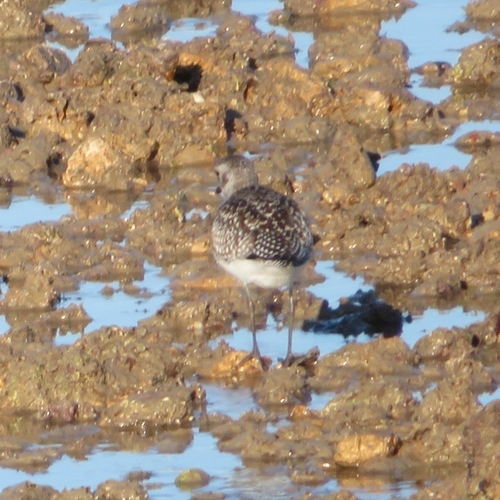
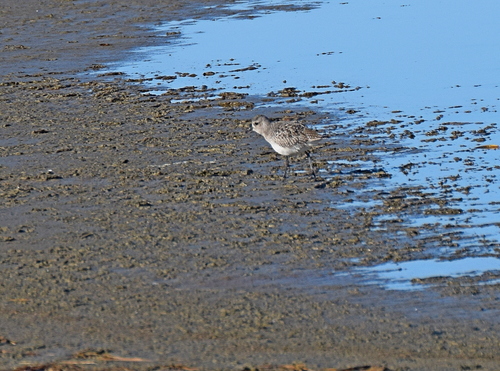
ID tip
The grey plover is 27–30 cm (11–12 in) long with a wingspan of 71–83 cm (28–33 in) and a weight of 190–280 g (6.7–9.9 oz) (up to 345 g (12.2 oz) in preparation for migration). In spring and summer (late April or May to August), adults are spotted black and white on the back and wings. The face and neck are black with a white border; they have a black breast and belly and a white rump. The tail is white with black barring. The bill and legs are black.
Text from Wikipedia, licensed CC BY-SA 4.0.
When to see the Grey Plover
One bar for each month. Filled bars are the 11 months with records; pale bars are months with none. The wide bar is September, the month with the most records.
Where to see the Grey Plover
The map shades 185 countries with regular records, and 8 more in a lighter tone where the bird turns up only as a stray. Everything unshaded has no records. Countries are listed below the map.
Recorded as a rare visitor in Sudan, Tajikistan, Malta, Vanuatu, Eswatini, Laos, Bosnia & Herzegovina, Fiji.
About the Grey Plover
The grey plover or black-bellied plover is a large plover breeding in Arctic regions. It is a long-distance migrant, with a nearly worldwide coastal distribution when not breeding.
Text adapted from Wikipedia, licensed CC BY-SA 4.0.
Easily confused with
 European Golden PloverPluvialis apricariaThe European golden plover is quite thickset, with its wings only being slightly longer than its tail.
 Pacific Golden PloverPluvialis fulvaAdults are about 25 cm (9.8 in) long with a wingspan averaging 61 cm (24 in) At their lightest, fat free, the birds weigh around 135 g (4.8 oz) In March, the birds begin gaining weight.
 American Golden PloverPluvialis dominicaMeasurements:
Length: 24–28 cm (9+1⁄2–11 in)
Weight: 122–194 g (4+5⁄16–6+13⁄16 oz)
Wingspan: 65–67 cm (25+1⁄2–26+1⁄2 in)
The breeding adult American golden plover has a black face, neck, breast, and belly, with a white crown and nape that extends to the side of the breast.
American Golden PloverPluvialis dominicaMeasurements:
Length: 24–28 cm (9+1⁄2–11 in)
Weight: 122–194 g (4+5⁄16–6+13⁄16 oz)
Wingspan: 65–67 cm (25+1⁄2–26+1⁄2 in)
The breeding adult American golden plover has a black face, neck, breast, and belly, with a white crown and nape that extends to the side of the breast.
Side by side: European Golden Plover vs Grey Plover · Grey Plover vs Pacific Golden Plover · American Golden Plover vs Grey Plover
Learn the Grey Plover in the BeakBrain App
Photo and call practice. Coming soon to iPhone and Android.
Play today's Daily BirdEvery photo and recording on this page is credited to its author under the licence shown. Spotted a problem with this page, or have a better photo? Contribute.