Learn what every symbol on the card means.Full credits and sources at beakbrain.com/symbols
 ShrublandDomed nestTiny · 9 g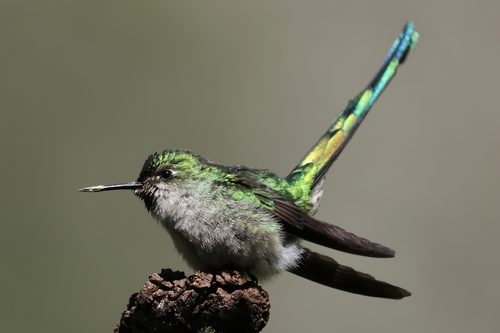
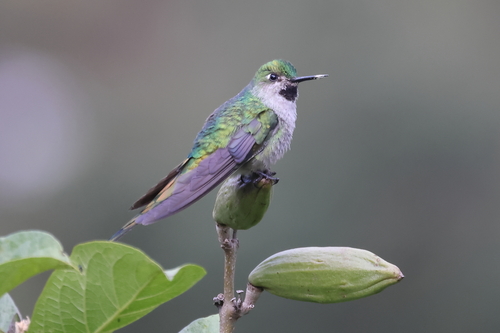
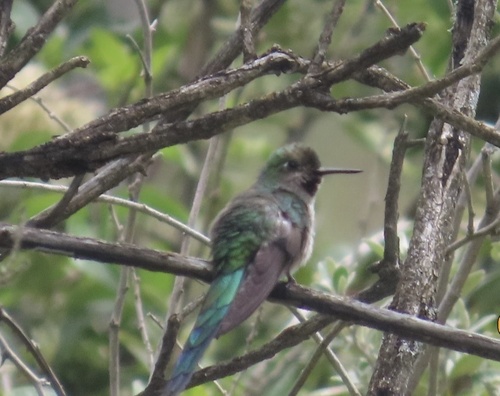
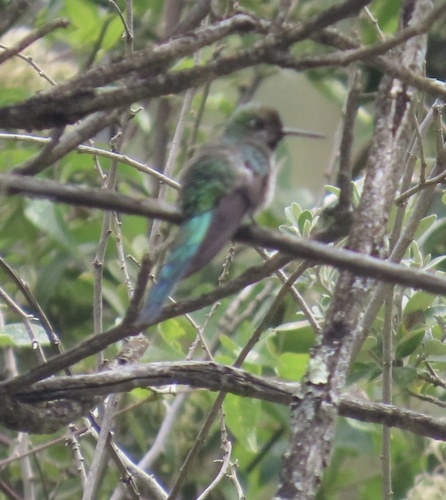
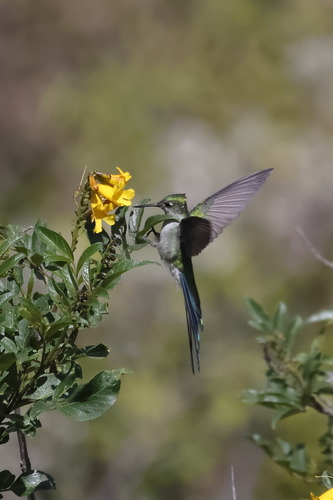
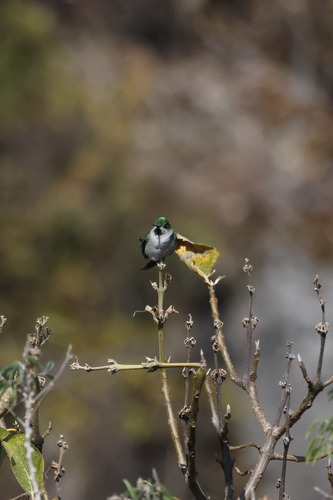
ID tip
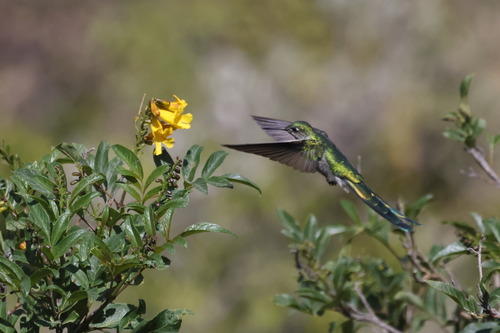
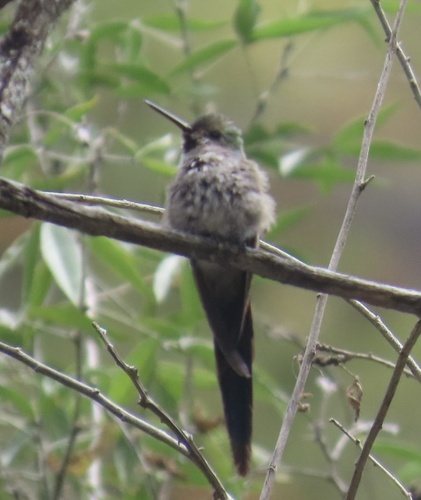
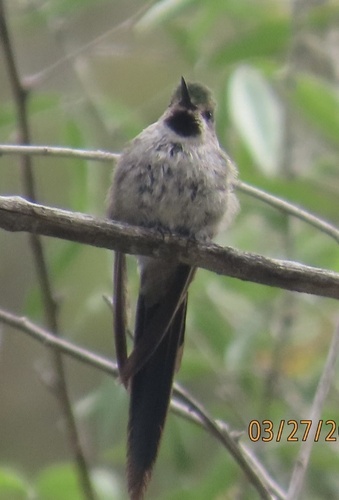
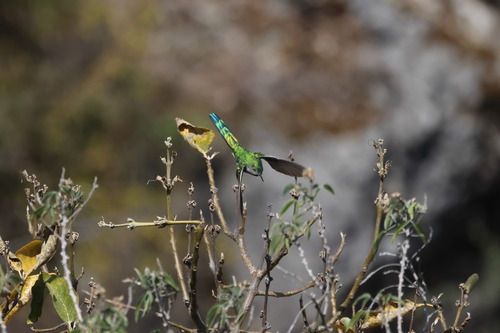
The grey-bellied comet is a large hummingbird with a long beak and a deeply forked tail, growing to 14 to 17 centimetres (5.5 to 6.7 in). The upperparts are bronzy-green and the long green tail feathers have orangeish tips. The underparts are grey and the male has a blue throat. The tail of the female is shorter than that of the male. Both sexes have a small white spot behind the eye.
Text from Wikipedia, licensed CC BY-SA 4.0.
When to see the Grey-bellied Comet
One bar for each month, and every month is filled: this bird is recorded here in all twelve. The wide bar is November, the month with the most records.
Where to see the Grey-bellied Comet
The map shades 1 country with regular records. Everything unshaded has no records. Countries are listed below the map.
About the Grey-bellied Comet
The grey-bellied comet is a species of hummingbird in the family Trochilidae. It is found only in a few small areas of Peru. Its natural habitats are subtropical or tropical high-altitude shrubland and rural gardens. It is threatened by habitat loss.
Text adapted from Wikipedia, licensed CC BY-SA 4.0.
Easily confused with
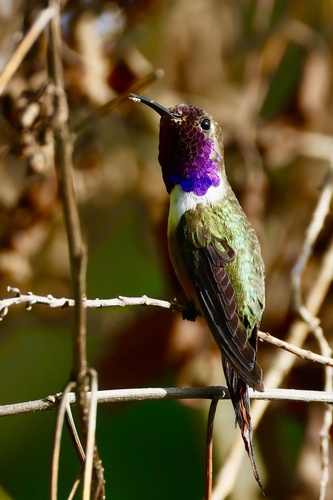 Inagua WoodstarNesophlox lyruraThe Inagua woodstar is 7.8 to 8.2 cm (3.1 to 3.2 in) long and weighs 2.1 to 2.7 g (0.074 to 0.095 oz).
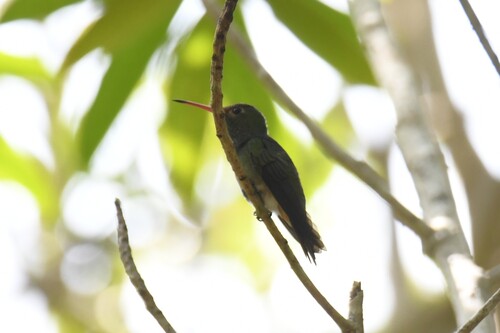 Humboldt's SapphireChrysuronia humboldtiiHumboldt's sapphire is 9 to 12.5 cm (3.5 to 4.9 in) long.
Outcrop SabrewingCampylopterus calcirupicolaThe outcrop sabrewing is very similar to its "parents", the grey-breasted and especially the Diamantina sabrewings.
Humboldt's SapphireChrysuronia humboldtiiHumboldt's sapphire is 9 to 12.5 cm (3.5 to 4.9 in) long.
Outcrop SabrewingCampylopterus calcirupicolaThe outcrop sabrewing is very similar to its "parents", the grey-breasted and especially the Diamantina sabrewings.
Learn the Grey-bellied Comet in the BeakBrain App
Photo and call practice. Coming soon to iPhone and Android.
Play today's Daily BirdEvery photo and recording on this page is credited to its author under the licence shown. Spotted a problem with this page, or have a better photo? Contribute.