Learn what every symbol on the card means.Full credits and sources at beakbrain.com/symbols
 UrbanCup nestTiny · 2 g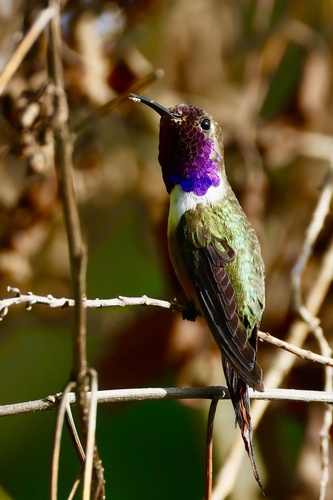

ID tip
The Inagua woodstar is 7.8 to 8.2 cm (3.1 to 3.2 in) long and weighs 2.1 to 2.7 g (0.074 to 0.095 oz). Both sexes have a short, slightly decurved, black bill and a small white spot behind the eye. The male's forehead and gorget are glittering reddish purple. Its upperparts are iridescent green, the breast whitish, and the belly mixed rufous and green. The tail is very deeply forked. Its central feathers are green and the others have cinnamon-rufous inner webs. The outermost feathers are lyre-shaped. Voice: As of July 2022, neither the Cornell Lab of Ornithology's Macaulay Library nor xeno-canto have recordings of the Inagua woodstar's vocalizations. Its song is described as quiet and simple, "sounding like wet, squeaking shoes". It also makes "chip" calls.
Text from Wikipedia, licensed CC BY-SA 4.0.
When to see the Inagua Woodstar
One bar for each month. Filled bars are the 8 months with records; pale bars are months with none. The wide bar is May, the month with the most records.
Where to see the Inagua Woodstar
The map shades 1 country with regular records. Everything unshaded has no records. Countries are listed below the map.
About the Inagua Woodstar
The Inagua woodstar, also called the lyre-tailed hummingbird, is a species of hummingbird in tribe Mellisugini of subfamily Trochilinae, the "bee hummingbirds". It is endemic to the two islands of the Inagua district of the Bahamas.
Text adapted from Wikipedia, licensed CC BY-SA 4.0.
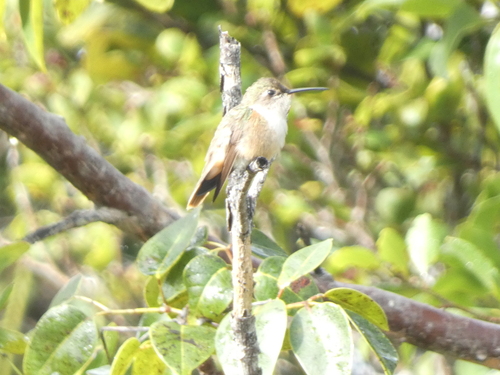
Easily confused with
Learn the Inagua Woodstar in the BeakBrain App
Photo and call practice. Coming soon to iPhone and Android.
Play today's Daily BirdEvery photo and recording on this page is credited to its author under the licence shown. Spotted a problem with this page, or have a better photo? Contribute.