Learn what every symbol on the card means.Full credits and sources at beakbrain.com/symbols
 ForestTiny · 7 g
ID tip
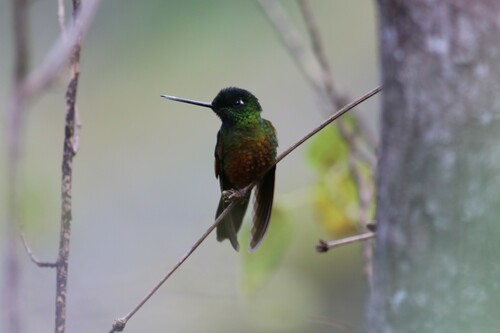
The green inca is about 14.5 cm (5.7 in) long; one female specimen weighed 6.7 g (0.24 oz). Adult males are mostly grass green, with a wide white collar across the upper breast. Their outer tail feathers are mostly white with green tips and their wings are brownish. Females are also mostly grass green above but with a smaller white collar and a rusty throat with green spots. The rest of their underparts are grayish with green mottling and spots. Voice: The green inca's most common vocalization is "a squeaky chatter". It also makes "a soft, low, reedy whistle "tu-tee", "a longer series...pip..pip..pip...", "a repeated phrase such as tsi-tsi-tsiririt...tsi-tsi-tsiririt...", and while foraging a "short spit or tsit".
Text from Wikipedia, licensed CC BY-SA 4.0.
When to see the Green Inca
One bar for each month, and every month is filled: this bird is recorded here in all twelve. The wide bar is March, the month with the most records.
Where to see the Green Inca
The map shades 1 country with regular records, and 1 more in a lighter tone where the bird turns up only as a stray. Everything unshaded has no records. Countries are listed below the map.
Recorded as a rare visitor in Colombia.
About the Green Inca
The green inca is a species of hummingbird in subfamily Lesbiinae, the so-called "typical hummingbirds", of family Trochilidae. It is found in Colombia and Venezuela.
Text adapted from Wikipedia, licensed CC BY-SA 4.0.
Easily confused with
 Gould's IncaCoeligena incaGould's inca is about 14.5 cm (5.7 in) long and weighs 6.8 to 7.2 g (0.24 to 0.25 oz).
 Golden-tailed StarfrontletCoeligena eosThe golden-tailed starfrontlet is about 11.4 cm (4.5 in) long including its 3.0 cm (1.2 in) bill.
 Perija StarfrontletCoeligena consitaThe Perija starfrontlet is about 11 cm (4.3 in) long including its 3.0 cm (1.2 in) bill.
Learn the Green Inca in the BeakBrain App
Photo and call practice. Coming soon to iPhone and Android.
Play today's Daily BirdEvery photo and recording on this page is credited to its author under the licence shown. Spotted a problem with this page, or have a better photo? Contribute.