Learn what every symbol on the card means.Full credits and sources at beakbrain.com/symbols
 ForestCup nestTiny · 7 g


ID tip
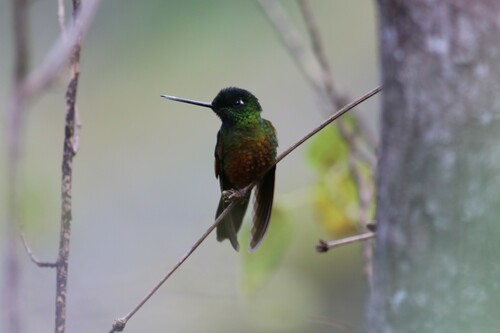
Gould's inca is about 14.5 cm (5.7 in) long and weighs 6.8 to 7.2 g (0.24 to 0.25 oz). Adult males of the nominate subspecies have a mostly velvety black head with a green forehead and a small white spot behind the eye. The rest of their upperparts are golden green that is shinier on the lower back. Their central pair of tail feathers is bronze-green and the rest are white with bronze-green tips. Their throat is black, their upper breast collar orange, their belly glittering green, and their undertail coverts golden-green with white fringes. Voice: The vocalization's of Gould's inca have not been described. Xeno-canto includes recordings within those of the collared inca. As of early 2023 Cornell Lab of Ornithology's Macaulay Library had one recording.
Text from Wikipedia, licensed CC BY-SA 4.0.
When to see the Gould's Inca
One bar for each month. Filled bars are the 10 months with records; pale bars are months with none. The wide bar is October, the month with the most records.
Where to see the Gould's Inca
The map shades 2 countries with regular records. Everything unshaded has no records. Countries are listed below the map.
About the Gould's Inca
Gould's inca is a species of hummingbird in subfamily Lesbiinae, the so-called "typical hummingbirds", of family Trochilidae. It is found in Bolivia and Peru.
Text adapted from Wikipedia, licensed CC BY-SA 4.0.
Easily confused with
 Golden-tailed StarfrontletCoeligena eosThe golden-tailed starfrontlet is about 11.4 cm (4.5 in) long including its 3.0 cm (1.2 in) bill.
 Perija StarfrontletCoeligena consitaThe Perija starfrontlet is about 11 cm (4.3 in) long including its 3.0 cm (1.2 in) bill.
Learn the Gould's Inca in the BeakBrain App
Photo and call practice. Coming soon to iPhone and Android.
Play today's Daily BirdEvery photo and recording on this page is credited to its author under the licence shown. Spotted a problem with this page, or have a better photo? Contribute.