Learn what every symbol on the card means.Full credits and sources at beakbrain.com/symbols
 ForestCavity nestSmall · 49 g


ID tip
They have dull ginger-olive plumage, but are yellower on the wings, and paler below. The head and chin are dark brown in the nominate race, and the eyes vary from dull red to orange. The bill is black and the feet blackish. Juveniles are duller, with brown eyes. Voice: Their call is a repetitive chock, chock, ..., or chop, chop, ..., sometimes in a duet.
Text from Wikipedia, licensed CC BY-SA 4.0.
When to see the Green Barbet
One bar for each month, and every month is filled: this bird is recorded here in all twelve. The wide bar is November, the month with the most records.
Where to see the Green Barbet
The map shades 5 countries with regular records. Everything unshaded has no records. Countries are listed below the map.
About the Green Barbet
The green barbet is a species of bird in the Lybiidae family. It is found in Kenya, Tanzania, Malawi, Mozambique and South Africa. It occurs in forests from sea level to 1,800 metres (5,900 ft). Its isolated populations are vulnerable to forest clearing.
Text adapted from Wikipedia, licensed CC BY-SA 4.0.
Easily confused with
 Brown-breasted BarbetPogonornis melanopterusThe brown-breasted barbet is a species of bird in the family Lybiidae.
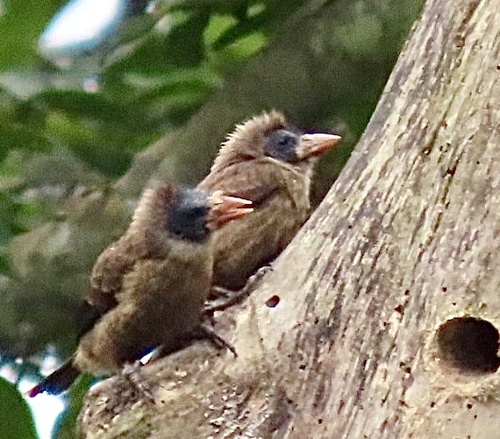 Naked-faced BarbetGymnobucco calvusThe naked-faced barbet is a bird species in the family Lybiidae.
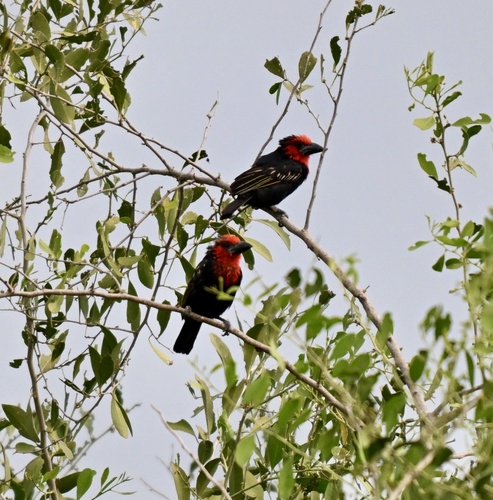 Black-billed BarbetLybius guifsobalitoLybius guifsobalito can reach a wingspan of 7.9–9.4 cm (3.1–3.7 in) in males.
Learn the Green Barbet in the BeakBrain App
Photo and call practice. Coming soon to iPhone and Android.
Play today's Daily BirdEvery photo and recording on this page is credited to its author under the licence shown. Spotted a problem with this page, or have a better photo? Contribute.