Learn what every symbol on the card means.Full credits and sources at beakbrain.com/symbols
 DesertCup nestSmall · 44 g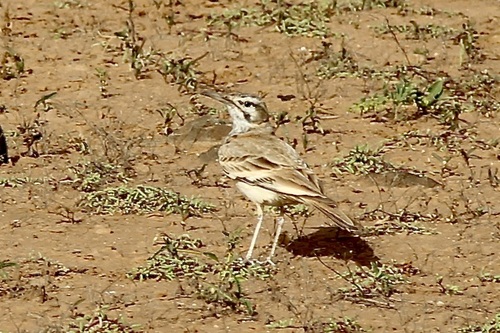
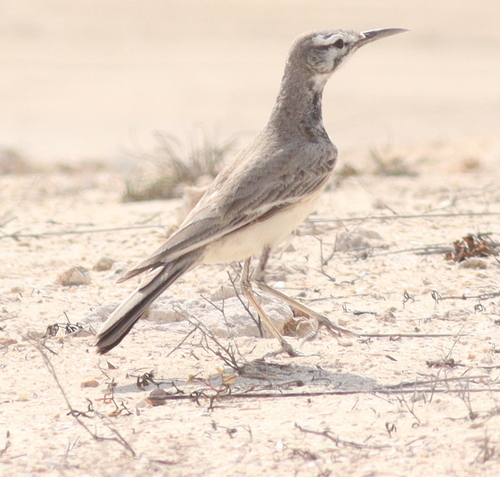


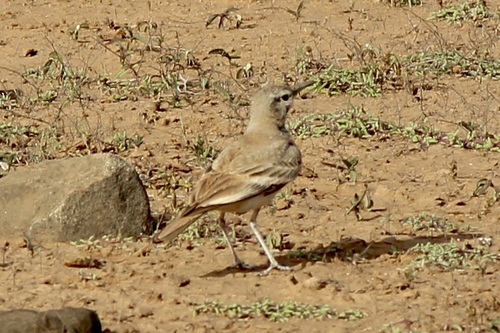
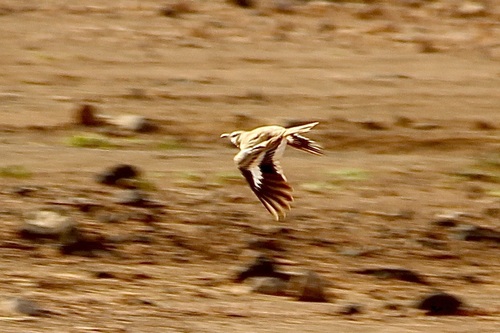

ID tip
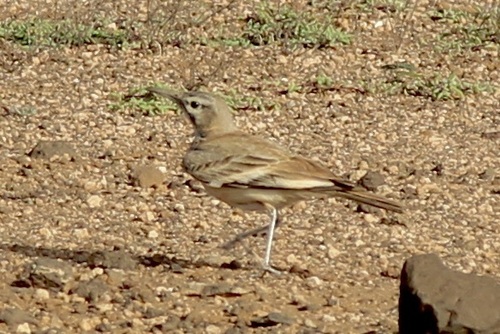
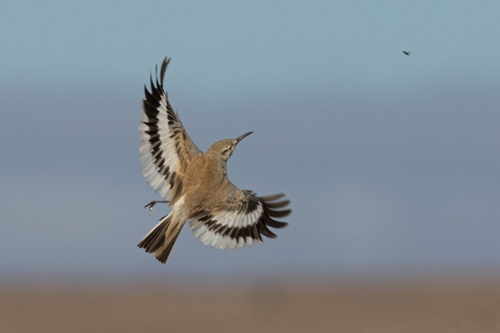
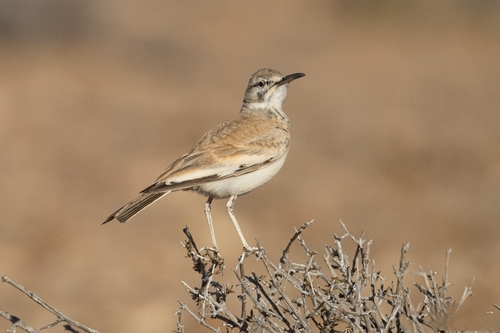
This lark is large, long-legged and slender-bodied with a distinctive down-curved bill. The face has dark markings including a line through the eye and whisker like-lines from the base of bill running under the eye. The breast is spotted and the underside is buffy white while the upper-parts are sandy grey. The female is slightly smaller with less prominent markings and the bill is slightly shorter. The hind claw is short and straight. The curved upper beak has the nostril opening exposed. The tongue is bifid at the tip.
Text from Wikipedia, licensed CC BY-SA 4.0.
When to see the Greater Hoopoe-Lark
One bar for each month. Filled bars are the 10 months with records; pale bars are months with none. The wide bar is March, the month with the most records.
Where to see the Greater Hoopoe-Lark
The map shades 28 countries with regular records, and 3 more in a lighter tone where the bird turns up only as a stray. Everything unshaded has no records. Countries are listed below the map.
About the Greater Hoopoe-Lark
The greater hoopoe-lark is a passerine bird which is a breeding resident of arid, desert and semi-desert regions from the Cape Verde Islands across much of northern Africa, through the Arabian Peninsula, Syria, Afghanistan, Pakistan and India. It was formerly known as the bifasciated lark and sometimes as the large desert lark.
Text adapted from Wikipedia, licensed CC BY-SA 4.0.
Easily confused with
Learn the Greater Hoopoe-Lark in the BeakBrain App
Photo and call practice. Coming soon to iPhone and Android.
Play today's Daily BirdEvery photo and recording on this page is credited to its author under the licence shown. Spotted a problem with this page, or have a better photo? Contribute.