Learn what every symbol on the card means.Full credits and sources at beakbrain.com/symbols
 WetlandPlatform nestHuge · 3.0 kg

What the Greater Flamingo sounds like


ID tip
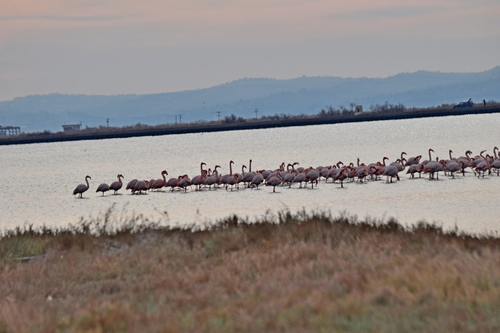
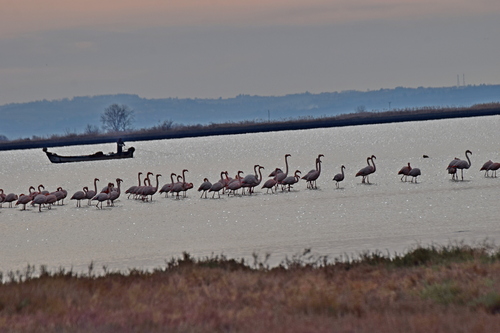
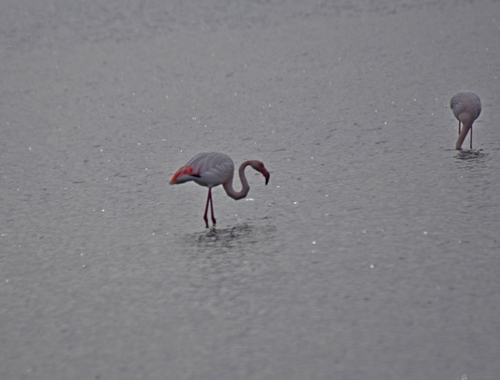
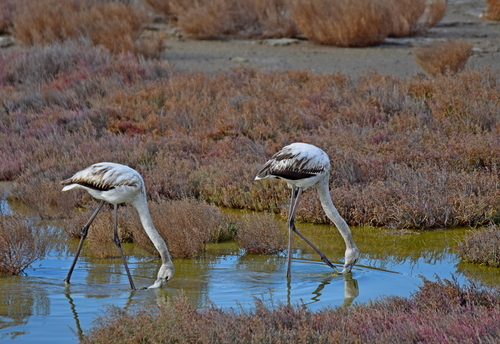
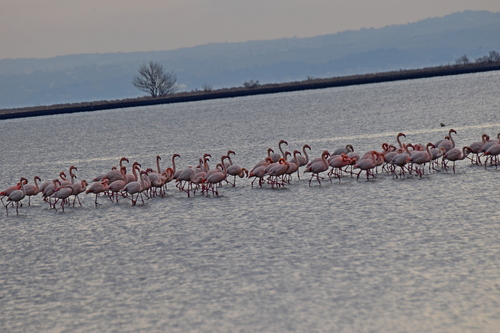
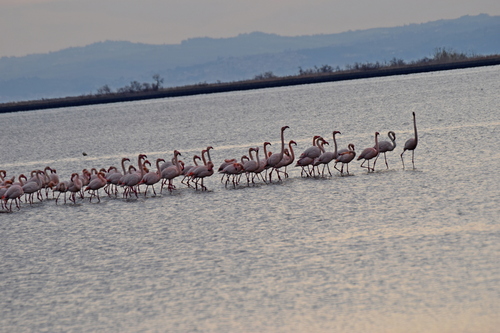
The greater flamingo is the largest living species of flamingo, averaging 110–150 cm (43–59 in) tall and weighing 2–4 kg (4.4–8.8 lb). Most of the plumage is pinkish-white, but the wing coverts are red and the primary and secondary flight feathers are black. The bill is pink with a restricted black tip, and the legs are entirely pink. The call is a goose-like honking. Chicks are covered in grey fluffy down. Subadult flamingos are paler with dark legs. Adults feeding chicks also become paler, but retain the bright pink legs.
Text from Wikipedia, licensed CC BY-SA 4.0.
When to see the Greater Flamingo
One bar for each month, and every month is filled: this bird is recorded here in all twelve. The wide bar is April, the month with the most records.
Where to see the Greater Flamingo
The map shades 78 countries with regular records, and 17 more in a lighter tone where the bird turns up only as a stray. Everything unshaded has no records. Countries are listed below the map.
Recorded as a rare visitor in Sweden, United States, United Kingdom, Norway, Belgium, Finland, Poland, Mongolia, Czechia, Seychelles, Japan, North Macedonia, Mauritius, Mayotte, Ecuador, Ireland, Serbia.
About the Greater Flamingo
The greater flamingo is the largest and most widespread species of the flamingo family. Common in the Old World, they are found in Northern (coastal) and Sub-Saharan Africa, the Indian subcontinent, Central Asia, the Middle East, the Levant, the Persian Gulf, the Gulf of Aden, the Red Sea, and the Mediterranean countries of Southern Europe.
Text adapted from Wikipedia, licensed CC BY-SA 4.0.
Easily confused with
 American FlamingoPhoenicopterus ruberThe American flamingo is a large wading bird with reddish-pink plumage.
 Chilean FlamingoPhoenicopterus chilensisThe Chilean flamingo's plumage is pinker than the slightly larger greater flamingo, but less so than the American flamingo.
Side by side: American Flamingo vs Greater Flamingo · Chilean Flamingo vs Greater Flamingo
Learn the Greater Flamingo in the BeakBrain App
Photo and call practice. Coming soon to iPhone and Android.
Play today's Daily BirdEvery photo and recording on this page is credited to its author under the licence shown. Spotted a problem with this page, or have a better photo? Contribute.