Learn what every symbol on the card means.Full credits and sources at beakbrain.com/symbols
 WoodlandDomed nestMedium · 281 g

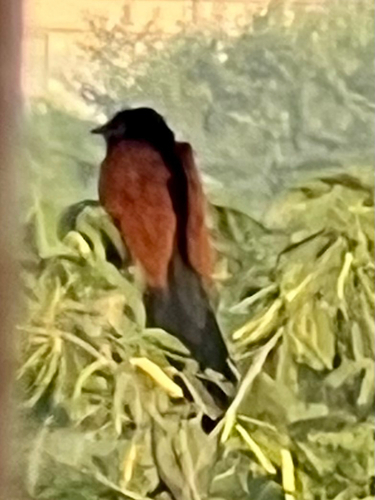
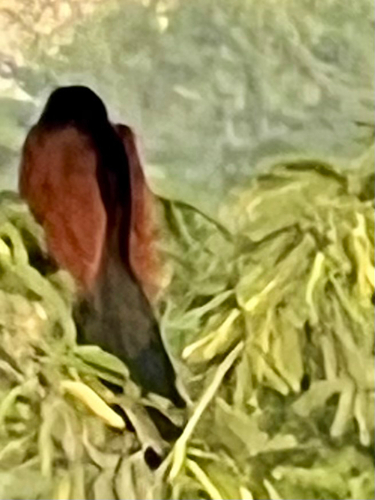
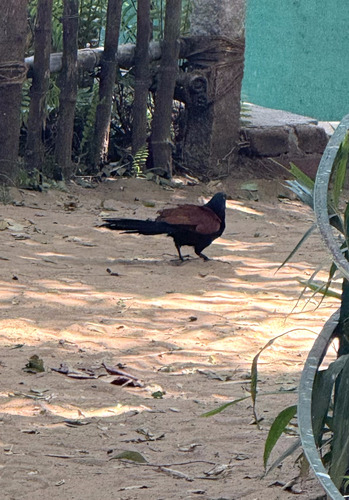
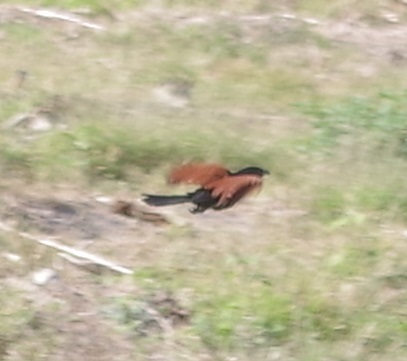
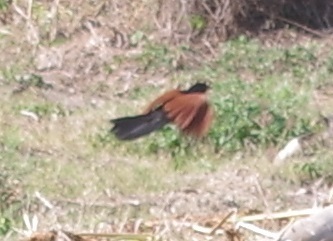
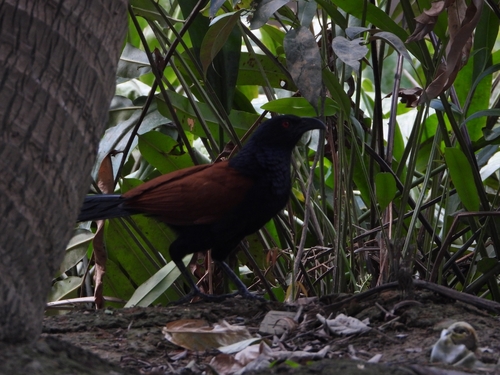
What the Greater Coucal sounds like

ID tip
This is a large species of cuckoo at 48 cm. The head is black, upper mantle and underside are black glossed with purple. The back and wings are chestnut brown. There are no pale shaft streaks on the coverts. The eyes are ruby red. Juveniles are duller black with spots on the crown and there are whitish bars on the underside and tail. There are several geographic races and some of these populations are sometimes treated as full species. Earlier treatments included the brown coucal (C. (s.) andamanensis) under this name.
Text from Wikipedia, licensed CC BY-SA 4.0.
When to see the Greater Coucal
One bar for each month, and every month is filled: this bird is recorded here in all twelve. The wide bar is February, the month with the most records.
Where to see the Greater Coucal
The map shades 20 countries with regular records, and 1 more in a lighter tone where the bird turns up only as a stray. Everything unshaded has no records. Countries are listed below the map.
Recorded as a rare visitor in Türkiye.
About the Greater Coucal
The greater coucal or crow pheasant, is a large non-parasitic member of the cuckoo order of birds, the Cuculiformes. A widespread resident in the Indian subcontinent and Southeast Asia, it is divided into several subspecies, some being treated as full species. They are large, crow-like with a long tail and coppery brown wings and found in a wide range of habitats from jungle to cultivation and urban gardens. They are weak fliers, and are often seen clambering about in vegetation or walking on the ground as they forage for insects, eggs and nestlings of other birds. They have a familiar deep resonant call which is associated with omens in many parts of its range.
Text adapted from Wikipedia, licensed CC BY-SA 4.0.
Easily confused with
 White-browed CoucalCentropus superciliosusThe white-browed coucal is a medium-sized species growing to 36 to 42 cm (14 to 17 in) in length.
 Pheasant CoucalCentropus phasianinus50 to 70 cm (20 to 28 in) in length, the pheasant coucal is a large heavy-set bird adapted for living on the ground, reminiscent of a pheasant in shape.
 Lesser CoucalCentropus bengalensisThis slightly smaller-sized and shorter-billed coucal has a very long hind claw, the longest within the genus.
Side by side: Greater Coucal vs White-browed Coucal · Greater Coucal vs Pheasant Coucal · Greater Coucal vs Lesser Coucal
Learn the Greater Coucal in the BeakBrain App
Photo and call practice. Coming soon to iPhone and Android.
Play today's Daily BirdEvery photo and recording on this page is credited to its author under the licence shown. Spotted a problem with this page, or have a better photo? Contribute.