Learn what every symbol on the card means.Full credits and sources at beakbrain.com/symbols
 WetlandPlatform nestHuge · 5.0 kg


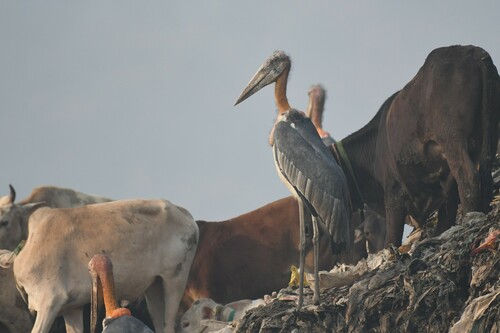
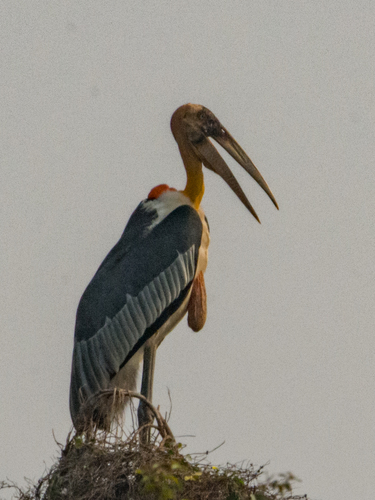
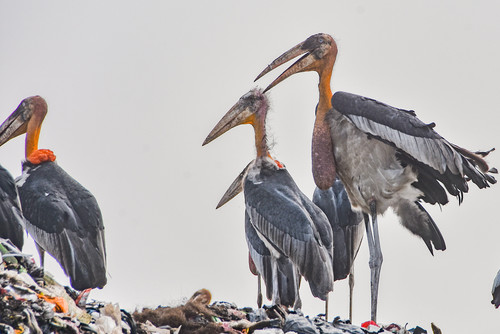
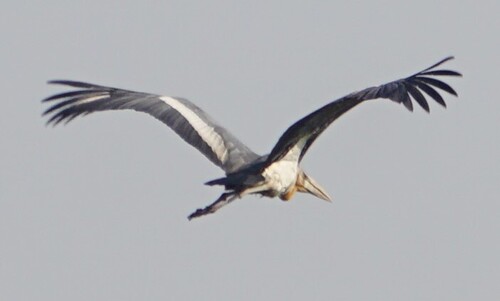

ID tip
The greater adjutant is a huge bird, standing tall at 145–150 cm (4 ft 9 in – 4 ft 11 in). The average length is 136 cm (4 ft 6 in) and average wingspan is 250 cm (8 ft 2 in), it may rival its cousin the marabou stork (Leptoptilos crumeniferus) as the largest winged extant stork. While no weights have been published for wild birds, the greater adjutant is among the largest of living storks, with published measurements overlapping with those of the jabiru (Jabiru mycteria), saddle-billed stork (Ephippiorhynchus senegalensis) and marabou stork (Leptoptilos crumeniferus).
Text from Wikipedia, licensed CC BY-SA 4.0.
When to see the Greater Adjutant
One bar for each month. Filled bars are the 6 months with records; pale bars are months with none. The wide bar is January, the month with the most records.
Where to see the Greater Adjutant
The map shades 3 countries with regular records, and 2 more in a lighter tone where the bird turns up only as a stray. Everything unshaded has no records. Countries are listed below the map.
About the Greater Adjutant
The greater adjutant is a member of the stork family, Ciconiidae. Its genus includes the lesser adjutant of Asia and the marabou stork of Africa. Once found widely across southern Asia and mainland southeast Asia, the greater adjutant is now restricted to a much smaller range with only three breeding populations; two in India, one in the north-eastern state of Assam and a smaller one around Bhagalpur; and another breeding population in Cambodia. They disperse widely after the breeding season. This large stork has a massive wedge-shaped bill, a bare head and a distinctive neck pouch. During the day, it soars in thermals along with vultures with whom it shares the habit of scavenging.
Text adapted from Wikipedia, licensed CC BY-SA 4.0.
Easily confused with
 Lesser AdjutantLeptoptilos javanicusA large stork with an upright stance, a bare head and neck without a pendant pouch, it has a length of 87–93 cm (34–37 in) (outstretched from bill-to-tail measurement), weighs from 4 to 5.71 kg (8.8 to 12.6 lb) and stands about 110–120 cm (43–47 in) tall.
 Marabou StorkLeptoptilos crumeniferThe marabou stork is a massive bird: large specimens are thought to reach a height of 152 centimetres (5 feet) and a weight of 9 kg (20 lb).
Side by side: Greater Adjutant vs Marabou Stork · Greater Adjutant vs Lesser Adjutant
Learn the Greater Adjutant in the BeakBrain App
Photo and call practice. Coming soon to iPhone and Android.
Play today's Daily BirdEvery photo and recording on this page is credited to its author under the licence shown. Spotted a problem with this page, or have a better photo? Contribute.