Learn what every symbol on the card means.Full credits and sources at beakbrain.com/symbols
 WoodlandCavity nestSmall · 16 g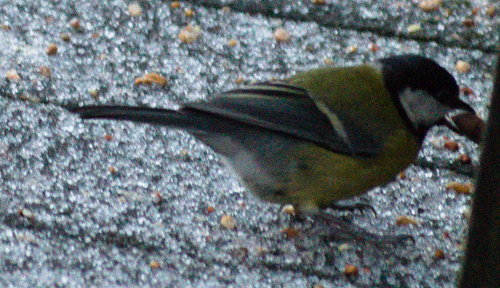







What the Great Tit sounds like


ID tip
The great tit is large for a tit at 12.5 to 14 cm (4+7⁄8–5+1⁄2 in) in length, and has a distinctive appearance that makes it easy to recognise. The nominate race P. major major has a bluish-black crown, black neck, throat, bib and head, and white cheeks and ear coverts. The breast is bright lemon-yellow and there is a broad black mid-line stripe running from the bib to vent. There is a dull white spot on the neck turning to greenish yellow on the upper nape. The rest of the nape and back are green tinged with olive. Voice: The great tit is, like other tits, a vocal bird, and has up to 40 types of calls and songs. The calls are generally the same between the sexes, but the male is much more vocal and the female rarely calls. Soft single notes such as "pit", "spick", or "chit" are used as contact calls. A loud "tink" is used by adult males as an alarm or in territorial disputes.
Text from Wikipedia, licensed CC BY-SA 4.0.
When to see the Great Tit
One bar for each month. Filled bars are the 11 months with records; pale bars are months with none. The wide bar is June, the month with the most records.
Where to see the Great Tit
The map shades 75 countries with regular records, and 7 more in a lighter tone where the bird turns up only as a stray. Everything unshaded has no records. Countries are listed below the map.
Recorded as a rare visitor in United States, India, Iceland, Canada, North Korea, Vietnam, Afghanistan.
About the Great Tit
The great tit is a small passerine bird in the tit family Paridae. It is widespread and common throughout Europe, the Middle East, Central Asia and as far east as the Amur River. It also occurs in parts of North Africa where it is generally resident in any sort of woodland. Most great tits do not migrate, except in extremely harsh winters. Until 2005 this species was lumped with numerous other subspecies. However, DNA studies have revealed that these subspecies are distinct from the great tit, and they have now been classified as two distinct species, the cinereous tit of southern Asia, and the Japanese tit of East Asia. The great tit remains the most widespread species in the genus Parus.
Text adapted from Wikipedia, licensed CC BY-SA 4.0.
Easily confused with
 Cinereous TitParus cinereusLike others in the genus, it has a broad black ventral line and has no crest.
 Green-backed TitParus monticolusThe green-backed tit is a species of bird in the family Paridae.
Side by side: Cinereous Tit vs Great Tit
Learn the Great Tit in the BeakBrain App
Photo and call practice. Coming soon to iPhone and Android.
Play today's Daily BirdEvery photo and recording on this page is credited to its author under the licence shown. Spotted a problem with this page, or have a better photo? Contribute.