Learn what every symbol on the card means.Full credits and sources at beakbrain.com/symbols
 UrbanCavity nestMedium · 63 g






What the Great Kiskadee sounds like


ID tip
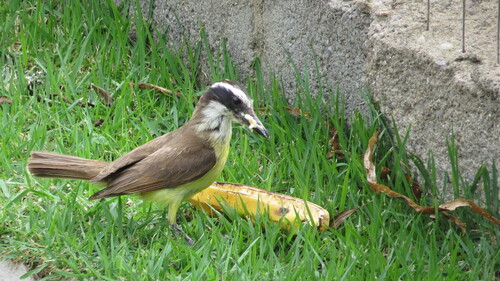
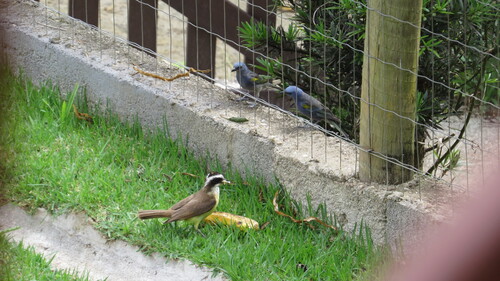
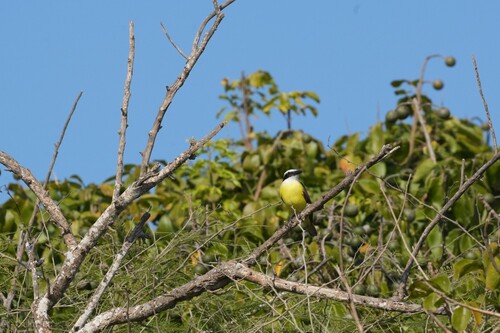
The adult great kiskadee is one of the largest of the tyrant flycatchers. It is 25 to 28 cm (9.8 to 11.0 in) in length and weighs 53 to 71.5 g (1.87 to 2.52 oz). The head is black with a strong white supercilium and a concealed yellow crown stripe. The upperparts are brown, and the wings and tail are brown with usually strong rufous fringes. The bill is short, thick, and black in color. The similar boat-billed flycatcher (Megarynchus pitangua) has a more massive black bill, an olive-brown back, and very little rufous in the tail and wings.
Text from Wikipedia, licensed CC BY-SA 4.0.
When to see the Great Kiskadee
One bar for each month, and every month is filled: this bird is recorded here in all twelve. The wide bar is January, the month with the most records.
Where to see the Great Kiskadee
The map shades 26 countries with regular records, and 1 more in a lighter tone where the bird turns up only as a stray. Everything unshaded has no records. Countries are listed below the map.
Recorded as a rare visitor in Canada.
About the Great Kiskadee
The great kiskadee is a passerine bird in the tyrant flycatcher family Tyrannidae. It is the only member of the genus Pitangus. It breeds in open woodland with some tall trees, including cultivation and around human habitation. It is found from the extreme southern United States south to Argentina. It was introduced to Bermuda in 1957, and to Tobago in about 1970.
Text adapted from Wikipedia, licensed CC BY-SA 4.0.
Easily confused with
 Tropical KingbirdTyrannus melancholicusAn adult tropical kingbird is 22 cm (8.7 in) long, weighs 39 g (1.4 oz) and has a wingspan range of 38–41 cm.
 Say's PhoebeSayornis sayaSay's phoebe is a barrel-chested bird with a squared-off head.
 Black PhoebeSayornis nigricansThe black phoebe is a medium-sized flycatcher, being 16 cm (6.3 in) in length and weighing 15 to 22 g (0.5 to 0.8 oz).
Side by side: Black Phoebe vs Great Kiskadee · Great Kiskadee vs Tropical Kingbird · Great Kiskadee vs Say's Phoebe
Learn the Great Kiskadee in the BeakBrain App
Photo and call practice. Coming soon to iPhone and Android.
Play today's Daily BirdEvery photo and recording on this page is credited to its author under the licence shown. Spotted a problem with this page, or have a better photo? Contribute.