Learn what every symbol on the card means.Full credits and sources at beakbrain.com/symbols
 RockyCup nestSmall · 19 g


What the Black Phoebe sounds like


ID tip
The black phoebe is a medium-sized flycatcher, being 16 cm (6.3 in) in length and weighing 15 to 22 g (0.5 to 0.8 oz). It has predominantly black plumage, with white on its belly and undertail coverts. The white forms an inverted "V" in the lower breast. The sexes are identical and plumage does not vary seasonally. Juveniles have browner plumage, cinnamon-brown feather tips on their body, and brown wing-bars. The bird has brown irises and black legs, feet, and beak.
Text from Wikipedia, licensed CC BY-SA 4.0.
When to see the Black Phoebe
One bar for each month, and every month is filled: this bird is recorded here in all twelve. The wide bar is January, the month with the most records.
Where to see the Black Phoebe
The map shades 16 countries with regular records. Everything unshaded has no records. Countries are listed below the map.
About the Black Phoebe
The black phoebe is a passerine bird in the tyrant-flycatcher family. It breeds from southwest Oregon and California south through Central and South America. It occurs year-round throughout most of its range and migrates less than the other birds in its genus though its northern populations are partially migratory. Six subspecies are commonly recognized although two are occasionally combined as a separate species, the white-winged phoebe.
Text adapted from Wikipedia, licensed CC BY-SA 4.0.
Easily confused with
 Say's PhoebeSayornis sayaSay's phoebe is a barrel-chested bird with a squared-off head.
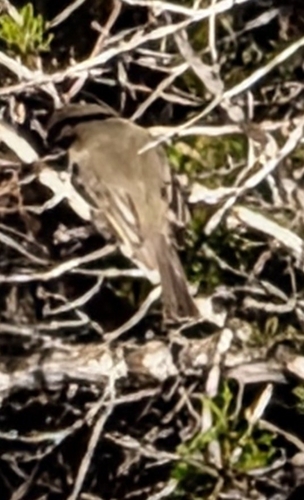 Eastern PhoebeSayornis phoebeMeasurements:
Length: 5.5–6.7 in (14–17 cm)
Weight: 0.6–0.7 oz (16–21 g)
Wingspan: 10.2–11.0 in (26–28 cm)
This species appears remarkably big-headed, especially if it puffs up the small crest.
Eastern PhoebeSayornis phoebeMeasurements:
Length: 5.5–6.7 in (14–17 cm)
Weight: 0.6–0.7 oz (16–21 g)
Wingspan: 10.2–11.0 in (26–28 cm)
This species appears remarkably big-headed, especially if it puffs up the small crest.
Side by side: Black Phoebe vs Eastern Phoebe · Black Phoebe vs Great Kiskadee · Black Phoebe vs Say's Phoebe
Learn the Black Phoebe in the BeakBrain App
Photo and call practice. Coming soon to iPhone and Android.
Play today's Daily BirdEvery photo and recording on this page is credited to its author under the licence shown. Spotted a problem with this page, or have a better photo? Contribute.