Learn what every symbol on the card means.Full credits and sources at beakbrain.com/symbols
 ForestScrapeHuge · 1.6 kg


What the Great Horned Owl sounds like


ID tip
The great horned owl is generally colored for camouflage. The underparts of the species are usually light with some brown horizontal barring; the upper parts and upper wings are generally a mottled brown usually bearing heavy, complex, darker markings. All subspecies are darkly barred to some extent along the sides. A variable-sized white patch is seen on the throat. The white throat may continue as a streak running down the middle of the breast even when the birds are not displaying, which in particularly pale individuals can widen at the belly into a large white area. Voice: The great horned owl's song is normally a low-pitched but loud ho-ho-hoo hoo hoo (or also transcribed as bu-bubu booh, who-hoo-ho-oo or who-ho-o-o, whoo-hoo-o-o, whoo) and can last for four or five syllables. The call is resonant and has warranted descriptions as varied as "solemn" and "terrifying". The female's call is higher and rises in pitch at the end of the call.
Text from Wikipedia, licensed CC BY-SA 4.0.
When to see the Great Horned Owl
One bar for each month. Filled bars are the 11 months with records; pale bars are months with none. The wide bar is April, the month with the most records.
Where to see the Great Horned Owl
The map shades 20 countries with regular records, and 1 more in a lighter tone where the bird turns up only as a stray. Everything unshaded has no records. Countries are listed below the map.
Recorded as a rare visitor in St. Pierre & Miquelon.
About the Great Horned Owl
The great horned owl, also known as the tiger owl or the hoot owl, is a large owl native to the Americas. It is an extremely adaptable bird with a vast range and is the most widely distributed true owl in the Americas. Its diet consists primarily of rabbits and hares, rats and mice, and voles; it remains one of the few regular predators of skunk. Hunting also includes rodents, larger mid-sized mammals, birds, reptiles, amphibians, and invertebrates.
Text adapted from Wikipedia, licensed CC BY-SA 4.0.
Easily confused with
 Snowy OwlBubo scandiacusThe snowy owl is mostly white.
 Eurasian Eagle-OwlBubo buboThe Eurasian eagle-owl is among the larger birds of prey, smaller than the golden eagle (Aquila chrysaetos), but larger than the snowy owl (Bubo scandiacus), despite some overlap in size with both of those species.
 Spotted Eagle-OwlBubo africanusThe spotted eagle-owl, also known as the African spotted eagle-owl and the African eagle-owl, is a medium-sized species of owl, one of the smallest of the eagle owls.
Side by side: Great Horned Owl vs Snowy Owl · Eurasian Eagle-Owl vs Great Horned Owl
Watch the Great Horned Owl on live cams
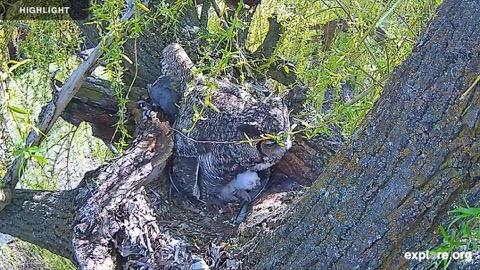 RETURNS MARCH
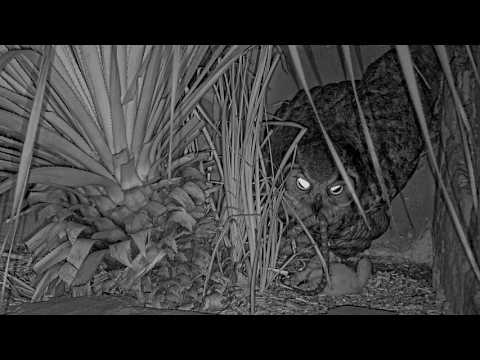 RETURNS FEBRUARY
Browse all 118 bird cams worldwide, live and seasonal, by region and species.
Learn the Great Horned Owl in the BeakBrain App
Photo and call practice. Coming soon to iPhone and Android.
Play today's Daily BirdEvery photo and recording on this page is credited to its author under the licence shown. Spotted a problem with this page, or have a better photo? Contribute.