Learn what every symbol on the card means.Full credits and sources at beakbrain.com/symbols
 ForestCavity nestMedium · 194 g


ID tip
The golden parakeet is 34–36 cm (13–14 in) long and mainly yellow with green in the outer wings and with an all-yellow tail. It has a large horn-colored (gray) beak, pale-pink bare eye rings, brown irises, and pink legs. Males and females have identical external appearance. Juveniles are duller and have less yellow and more green plumage than the adults. The juvenile's head and neck are mostly green, the back is green and yellow, the upper side of tail is mostly green, the breast is greenish, the eye rings are pale-gray, and the legs are brown.
Text from Wikipedia, licensed CC BY-SA 4.0.
When to see the Golden Parakeet
One bar for each month. Filled bars are the 9 months with records; pale bars are months with none. The wide bar is August, the month with the most records.
Where to see the Golden Parakeet
The map shades 1 country with regular records. Everything unshaded has no records. Countries are listed below the map.
About the Golden Parakeet
The golden parakeet, golden conure, or Queen of Bavaria conure is a medium-sized golden-yellow Neotropical parrot native to the Amazon Basin of interior northern Brazil. It is the only species placed in the genus Guaruba.
Text adapted from Wikipedia, licensed CC BY-SA 4.0.
Easily confused with
 Timneh ParrotPsittacus timnehGrowing to 28–33 centimetres (11–13 in) in length and weighing 275–375 grams (9.7–13.2 oz), the Timneh is a medium-sized parrot.
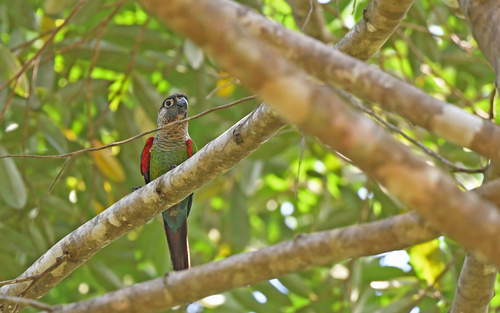 Pearly ParakeetPyrrhura lepidaThe pearly parakeet is 24 to 25 cm (9.4 to 9.8 in) long and weighs 70 to 80 g (2.5 to 2.8 oz).
Bald ParrotPyrilia aurantiocephalaThe bald parrot is a medium-small, overall green parrot with a bald, brownish-orange head.
Pearly ParakeetPyrrhura lepidaThe pearly parakeet is 24 to 25 cm (9.4 to 9.8 in) long and weighs 70 to 80 g (2.5 to 2.8 oz).
Bald ParrotPyrilia aurantiocephalaThe bald parrot is a medium-small, overall green parrot with a bald, brownish-orange head.
Learn the Golden Parakeet in the BeakBrain App
Photo and call practice. Coming soon to iPhone and Android.
Play today's Daily BirdEvery photo and recording on this page is credited to its author under the licence shown. Spotted a problem with this page, or have a better photo? Contribute.