Learn what every symbol on the card means.Full credits and sources at beakbrain.com/symbols
 ShrublandCup nestSmall · 19 g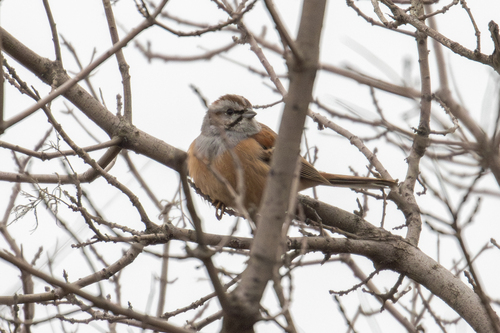


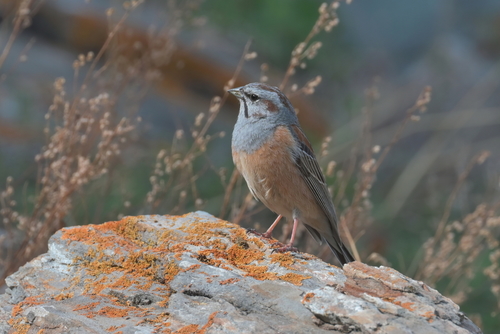
ID tip
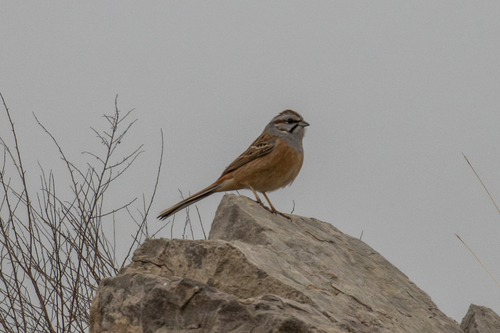
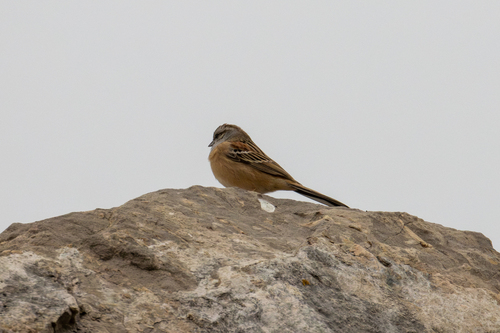
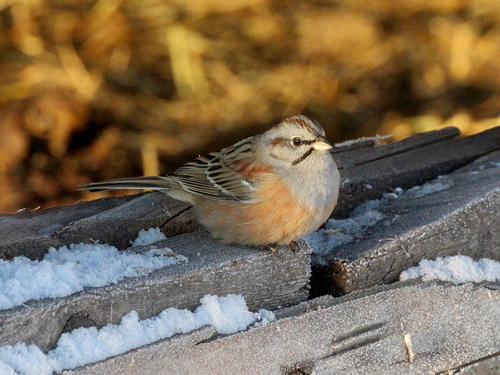
The adult's head, neck, and breast are grey over-all with a brown or black eye stripe, "mustache", and crown. Its underparts and rump are an orange/buff wash and its back is mottled orange and black. The tail is black and orange above and white beneath, with a definite notch at the end. It has a sparrow-like beak which is black above and pale below. The legs and feet are light pink.
Text from Wikipedia, licensed CC BY-SA 4.0.
When to see the Godlewski's Bunting
One bar for each month. Filled bars are the 11 months with records; pale bars are months with none. The wide bar is June, the month with the most records.
Where to see the Godlewski's Bunting
The map shades 7 countries with regular records, and 1 more in a lighter tone where the bird turns up only as a stray. Everything unshaded has no records. Countries are listed below the map.
Recorded as a rare visitor in Vietnam.
About the Godlewski's Bunting
Godlewski's bunting is a species of bird in the family Emberizidae. It is named after the Polish collector Victor Godlewski who obtained a specimen of which on the basis of which it was described by Taczanowski.
Text adapted from Wikipedia, licensed CC BY-SA 4.0.
Easily confused with
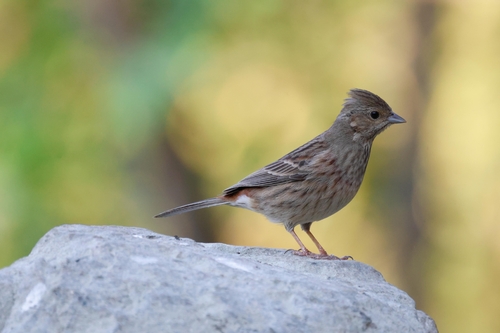 White-capped BuntingEmberiza stewartiThe white-capped bunting or chestnut-breasted bunting is a species of bird in the family Emberizidae.
 Chestnut BuntingEmberiza rutilaIt is a fairly small bunting, 14 to 15 cm in length.
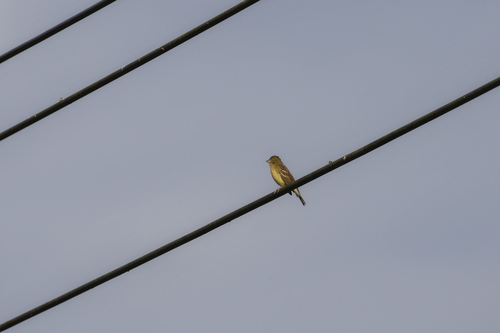 Yellow BuntingEmberiza sulphurataIt is 14 cm long and has a conical, grey bill, pinkish-brown feet and brown eyes.
Side by side: Chestnut Bunting vs Godlewski's Bunting · Godlewski's Bunting vs Yellow Bunting
Learn the Godlewski's Bunting in the BeakBrain App
Photo and call practice. Coming soon to iPhone and Android.
Play today's Daily BirdEvery photo and recording on this page is credited to its author under the licence shown. Spotted a problem with this page, or have a better photo? Contribute.