Learn what every symbol on the card means.Full credits and sources at beakbrain.com/symbols
 WoodlandCavity nestSmall · 41 g


ID tip
The upperparts are dark bluish-grey, with the crown, nape, and upper mantle much lighter grey and somewhat streaked with black, varyingly between individuals, regardless of sex. The crown is framed by two thick black eyestripes that extend to the top of the mantle; in profile, the bird can even give the impression of having a black head. The underparts are light grey, with almost white cheeks and throat, and the belly is more or less washed with cinnamon. The undertail coverts are rufous, with large white spots.
Text from Wikipedia, licensed CC BY-SA 4.0.
When to see the Giant Nuthatch
One bar for each month. Filled bars are the 5 months with records; pale bars are months with none. The wide bar is February, the month with the most records.
Where to see the Giant Nuthatch
The map shades 3 countries with regular records. Everything unshaded has no records. Countries are listed below the map.
About the Giant Nuthatch
The giant nuthatch is a species of bird in the family Sittidae. It is the longest of the nuthatches, measuring 19.5 cm (7.7 in) in length. Its upperparts are bluish grey, with the front being light grey, contrasting with the darker rest of the back. The bird has two very thick black eyebrow lines and light grey underparts, with whitish cheeks and throat, and a belly more or less washed with buff and cinnamon. For a nuthatch, it has a long beak and tail. The female can be distinguished from the male by its duller eye features and its upperparts having less contrast between the crown, nape, and lower back. The calls are powerful and made up of repetitions of simple patterns.
Text adapted from Wikipedia, licensed CC BY-SA 4.0.
Easily confused with
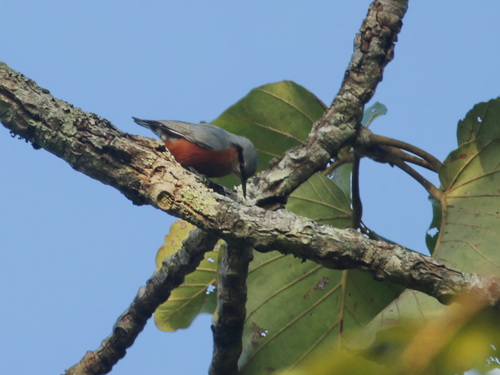 Burmese NuthatchSitta neglectaThe Burmese nuthatch, also known as the neglected nuthatch, is a species of bird in the family Sittidae.
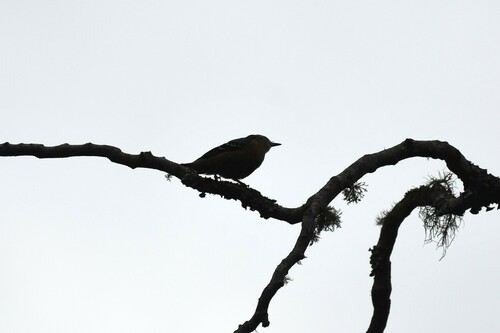 Beautiful NuthatchSitta formosaDescribed by Erik Matthysen in his 1998 treatise The Nuthatches as a bird that "deserves its name", the beautiful nuthatch has highly distinctive plumage.
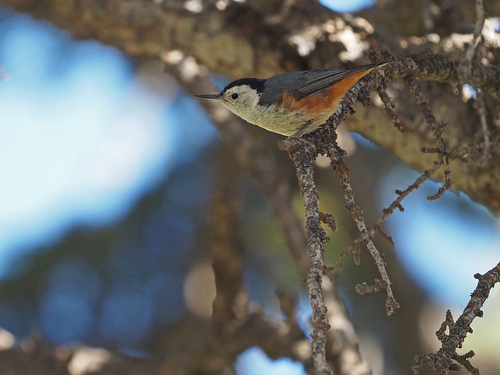 White-cheeked NuthatchSitta leucopsisIt is 13 cm (5.1 in) long, white cheeks, chin, throat, and underparts, upper parts mostly dark grey.
Learn the Giant Nuthatch in the BeakBrain App
Photo and call practice. Coming soon to iPhone and Android.
Play today's Daily BirdEvery photo and recording on this page is credited to its author under the licence shown. Spotted a problem with this page, or have a better photo? Contribute.