Learn what every symbol on the card means.Full credits and sources at beakbrain.com/symbols
 ShrublandCup nestSmall · 54 g


ID tip
Like all of the mockingbirds found in the Galápagos, this species is long-tailed and relatively long-legged, with a long, slim, decurved beak. The Galapagos mockingbird has a whitish stripe behind its eye, blackish-brown lores and ear-patch, and a broad white collar. The crown is dark brown, and the upperparts are greyish-brown with darker brown streaks. The flight-feathers are dark brown with two white wing-bars. It is whitish below, with a few brownish streaks on the breast and flanks. Its iris is yellowish, and the bill and legs are black.
Text from Wikipedia, licensed CC BY-SA 4.0.
When to see the Galapagos Mockingbird
One bar for each month, and every month is filled: this bird is recorded here in all twelve. The wide bar is July, the month with the most records.
Where to see the Galapagos Mockingbird
The map shades 1 country with regular records. Everything unshaded has no records. Countries are listed below the map.
About the Galapagos Mockingbird
The Galápagos mockingbird is a species of bird in the family Mimidae. It is endemic to the Galápagos Islands, Ecuador.
Text adapted from Wikipedia, licensed CC BY-SA 4.0.
Easily confused with
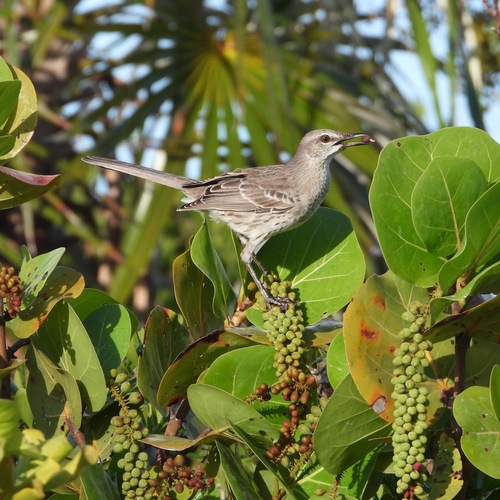 Bahama MockingbirdMimus gundlachiiThe Bahama mockingbird is 28 cm (11 in) long and weighs between 57 and 85 g (2.0 and 3.0 oz) with an average of 66.8 g (2.36 oz).
 Brown-backed MockingbirdMimus dorsalisThe brown-backed mockingbird is 21 to 25.5 cm (8.3 to 10.0 in) long and weighs between 52 and 65 g (1.8 and 2.3 oz) with an average of 58.7 g (2.07 oz).
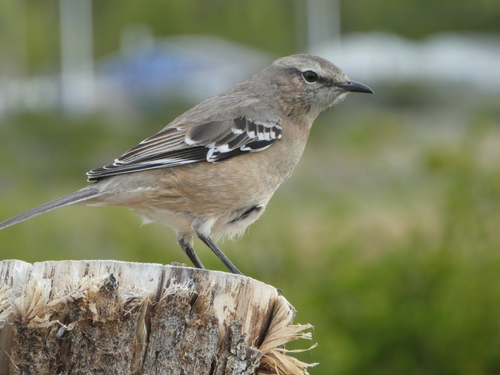 Patagonian MockingbirdMimus patagonicusThe Patagonian mockingbird is 22 to 25 cm (8.7 to 9.8 in) long.
Side by side: Galapagos Mockingbird vs Long-tailed Mockingbird · Galapagos Mockingbird vs White-banded Mockingbird · Galapagos Mockingbird vs Patagonian Mockingbird · Galapagos Mockingbird vs Scaly-breasted Thrasher · Bahama Mockingbird vs Galapagos Mockingbird
Learn the Galapagos Mockingbird in the BeakBrain App
Photo and call practice. Coming soon to iPhone and Android.
Play today's Daily BirdEvery photo and recording on this page is credited to its author under the licence shown. Spotted a problem with this page, or have a better photo? Contribute.