
Galapagos Mockingbird
Mimus parvulus
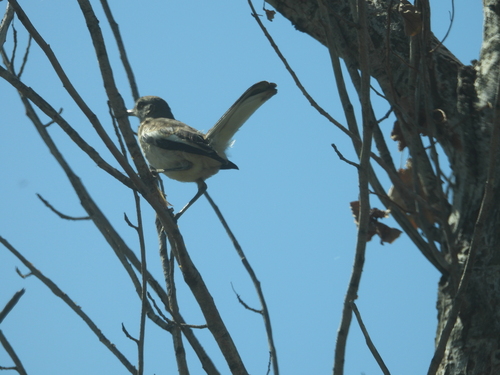
Like all of the mockingbirds found in the Galápagos, this species is long-tailed and relatively long-legged, with a long, slim, decurved beak. The Galapagos mockingbird has a whitish stripe behind its eye, blackish-brown lores and ear-patch, and a broad white collar. The crown is dark brown, and the upperparts are greyish-brown with darker brown streaks. The flight-feathers are dark brown with two white wing-bars. It is whitish below, with a few brownish streaks on the breast and flanks. Its iris is yellowish, and the bill and legs are black.
ID text from Wikipedia, CC BY-SA 4.0
White-banded Mockingbird
Mimus triurus
The white-banded mockingbird is 20 to 23.5 cm (7.9 to 9.3 in) long and weighs 49 to 54 g (1.7 to 1.9 oz). The male is slightly larger than the female. Adults have a grayish crown, a white supercilium, a blackish line through the eye, and speckled cheeks. Their upperparts are smoky gray blending to reddish cinnamon on the rump. The central third of the tail is black and the outer feathers white. The folded wing shows a broad white band; the rest of the wing is blackish. The white on the wings and tail are conspicuous in flight. Voice: The white-banded mockingbird is a "uperlative songster, the most outstanding of genus". Its song is " a long, loud and extended stream of melodic notes and phrases" and it is an excellent mimic.
ID text from Wikipedia, CC BY-SA 4.0
Learn this pair in the BeakBrain App
Photo and call practice. Coming soon to iPhone and Android.
Play today's Daily BirdPhotos and recordings are credited to their authors under the licence shown. Full profiles: Galapagos Mockingbird and White-banded Mockingbird.