Learn what every symbol on the card means.Full credits and sources at beakbrain.com/symbols
 WoodlandCup nestSmall · 40 g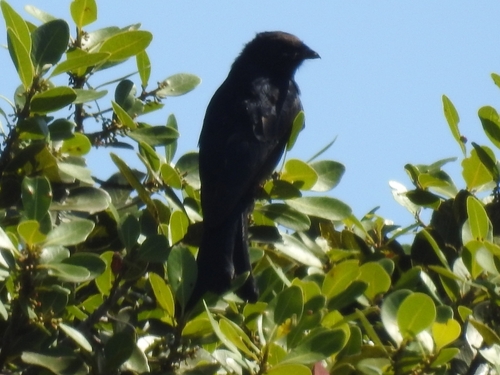




What the Fork-tailed Drongo sounds like


ID tip
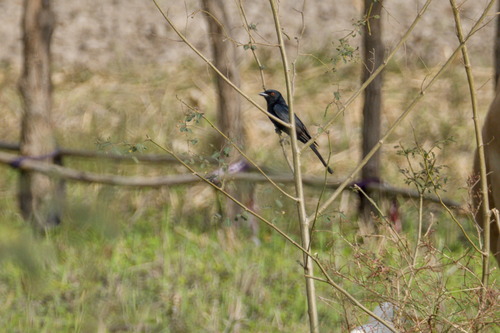
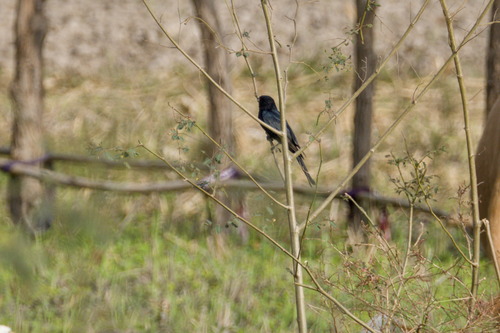
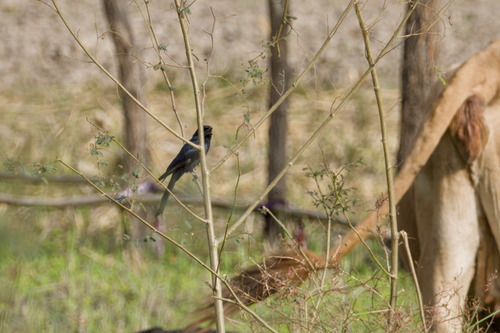
The bird possesses a robust black beak and red eyes. When born, they lack feathers, exhibiting reddish skin, an orange beak, yellow gape flange, brown eyes, and a black beak. Juvenile fork-tailed drongos are dark brown tone with some buff-colored feather tips, a less pronounced tail fork, brown or grey eyes, and a pale mouth. While resembling adults, they lack the glossy shine on the lower body and display pale feathers on certain areas. Both sexes share a black body with a blue-green iridescence in specific regions. Voice: This bird is notably vocal, often commencing the dawn chorus and often is the last heard at dusk. Their pre-dawn calls comprise variations such as jwaaa-jwaaa and jeewy-jeeerr. They exhibit a diverse repertoire of vocalizations, ranging from sharp calls, brief whistles, and squeaks to fluid, raspy, and scratchy notes delivered rapidly or with extended pauses.
Text from Wikipedia, licensed CC BY-SA 4.0.
When to see the Fork-tailed Drongo
One bar for each month, and every month is filled: this bird is recorded here in all twelve. The wide bar is November, the month with the most records.
Where to see the Fork-tailed Drongo
The map shades 40 countries with regular records, and 2 more in a lighter tone where the bird turns up only as a stray. Everything unshaded has no records. Countries are listed below the map.
Recorded as a rare visitor in Mauritania, India.
About the Fork-tailed Drongo
The fork-tailed drongo, also called the common drongo or African drongo, is a small bird found from the Sahel to South Africa that lives in wooded habitats, particularly woodlands and savannas. It is part of the family Dicruridae and has four recognized subspecies, D. a adsimilis, D. a. apivorus, D. a. fugax and D. a. jubaensis. Like other drongos, the fork-tailed is mostly insectivorous; its diet mainly consists of butterflies, termites, and grasshoppers.
Text adapted from Wikipedia, licensed CC BY-SA 4.0.
Easily confused with
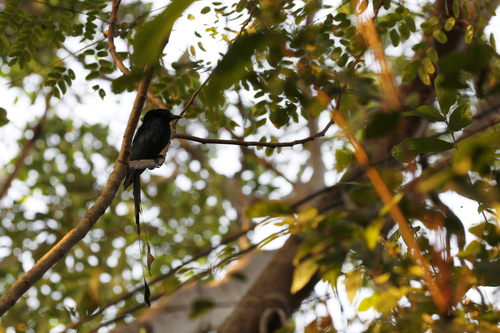 Greater Racket-tailed DrongoDicrurus paradiseusIn most of its range in Asia, this is the largest of the drongo species and is readily identifiable by the distinctive tail rackets and the crest of curled feather that begin in front of the face above the beak and along the crown to varying extents according to the subspecies.
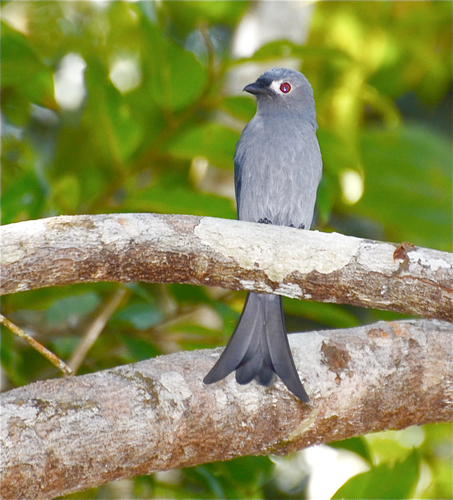 Ashy DrongoDicrurus leucophaeusThe adult ashy drongo is mainly dark grey, and the tail is long and deeply forked, There are a number of subspecies varying in the shade of the grey plumage.
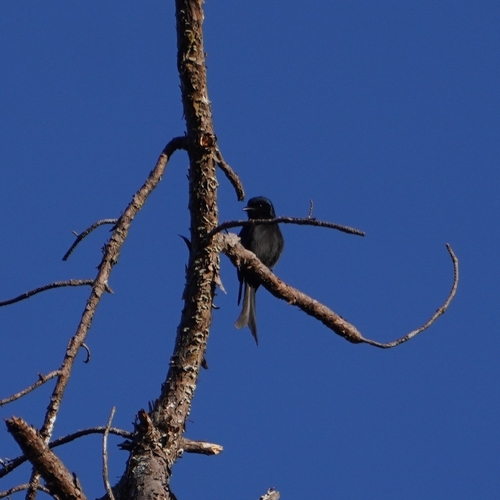 Bronzed DrongoDicrurus aeneusThis drongo is somewhat smaller than the black drongo and has more metallic gloss with a spangled appearance on the head, neck and breast.
Side by side: Black Drongo vs Fork-tailed Drongo · Fork-tailed Drongo vs Greater Racket-tailed Drongo · Ashy Drongo vs Fork-tailed Drongo · Bronzed Drongo vs Fork-tailed Drongo
Watch the Fork-tailed Drongo on live cams
Browse all 118 bird cams worldwide, live and seasonal, by region and species.
Learn the Fork-tailed Drongo in the BeakBrain App
Photo and call practice. Coming soon to iPhone and Android.
Play today's Daily BirdEvery photo and recording on this page is credited to its author under the licence shown. Spotted a problem with this page, or have a better photo? Contribute.