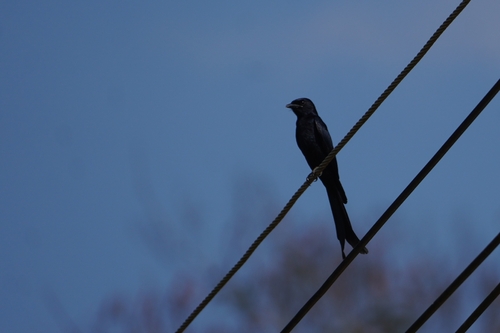
Black Drongo
Dicrurus macrocercus
This bird is glossy black with a wide fork to the tail. Adults usually have a small white spot at the base of the gape. The iris is dark brown (not crimson as in the similar ashy drongo). The sexes cannot be told apart in the field. Juveniles are brownish and may have some white barring or speckling towards the belly and vent, and can be mistaken for the white-bellied drongo. First-year birds have white tips to the feathers of the belly, while second-years have these white-tipped feathers restricted to the vent.
ID text from Wikipedia, CC BY-SA 4.0

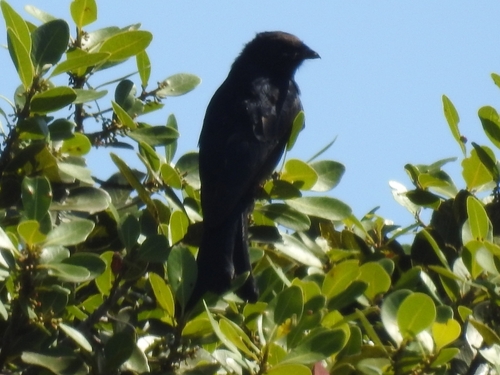
Fork-tailed Drongo
Dicrurus adsimilis
The bird possesses a robust black beak and red eyes. When born, they lack feathers, exhibiting reddish skin, an orange beak, yellow gape flange, brown eyes, and a black beak. Juvenile fork-tailed drongos are dark brown tone with some buff-colored feather tips, a less pronounced tail fork, brown or grey eyes, and a pale mouth. While resembling adults, they lack the glossy shine on the lower body and display pale feathers on certain areas. Both sexes share a black body with a blue-green iridescence in specific regions. Voice: This bird is notably vocal, often commencing the dawn chorus and often is the last heard at dusk. Their pre-dawn calls comprise variations such as jwaaa-jwaaa and jeewy-jeeerr. They exhibit a diverse repertoire of vocalizations, ranging from sharp calls, brief whistles, and squeaks to fluid, raspy, and scratchy notes delivered rapidly or with extended pauses.
ID text from Wikipedia, CC BY-SA 4.0

Learn this pair in the BeakBrain App
Photo and call practice. Coming soon to iPhone and Android.
Play today's Daily BirdPhotos and recordings are credited to their authors under the licence shown. Full profiles: Black Drongo and Fork-tailed Drongo.