Learn what every symbol on the card means.Full credits and sources at beakbrain.com/symbols
 WetlandScrapeLarge · 574 g



ID tip
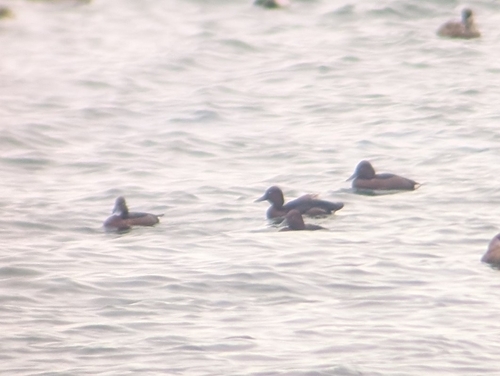
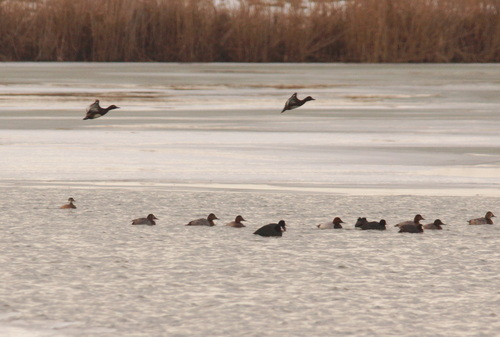
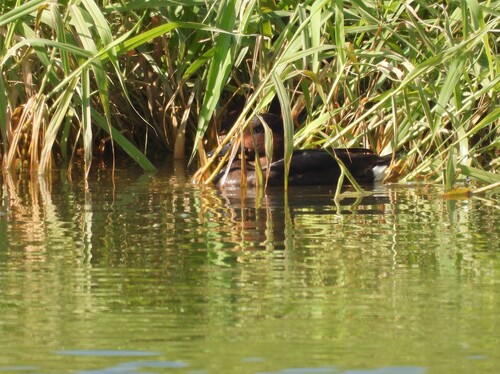
The breeding male is a rich, dark chestnut on the head, breast and flanks with contrasting pure white undertail coverts. In flight the white belly and underwing patch are visible. The females are duller and browner than the males. The male has a yellow eye and the females have a dark eye.
Text from Wikipedia, licensed CC BY-SA 4.0.
When to see the Ferruginous Duck
One bar for each month. Filled bars are the 11 months with records; pale bars are months with none. The wide bar is January, the month with the most records.
Where to see the Ferruginous Duck
The map shades 87 countries with regular records, and 4 more in a lighter tone where the bird turns up only as a stray. Everything unshaded has no records. Countries are listed below the map.
Recorded as a rare visitor in Finland, United States, Lebanon, Seychelles.
About the Ferruginous Duck
The ferruginous duck, also known as the ferruginous pochard, common white-eye or white-eyed pochard, is a medium-sized diving duck native to the Palearctic. The scientific name is derived from the Ancient Greek word, αἴθυιᾰ, an unknown seabird mentioned by authors including Hesychius and Aristotle, and the Russian word, нырок, the Russian word for pochard, which occurs in the bird's Russian common name.
Text adapted from Wikipedia, licensed CC BY-SA 4.0.
Easily confused with
 New Zealand ScaupAythya novaeseelandiaeThe New Zealand scaup is a small, round-bodied diving duck that have dark plumage, but both sexes are easily distinguished.
 Baer's PochardAythya baeriThe Baer's pochard is 41–47 cm (16–19 in) long with a 70–79 cm (28–31 in) wingspan.
 Madagascar PochardAythya innotataThe pochard is a medium-sized duck between 42 and 56 centimeters in size.
Side by side: Ferruginous Duck vs Hardhead · Ferruginous Duck vs New Zealand Scaup
Learn the Ferruginous Duck in the BeakBrain App
Photo and call practice. Coming soon to iPhone and Android.
Play today's Daily BirdEvery photo and recording on this page is credited to its author under the licence shown. Spotted a problem with this page, or have a better photo? Contribute.