Learn what every symbol on the card means.Full credits and sources at beakbrain.com/symbols
 MarineCavity nestHuge · 1.8 kg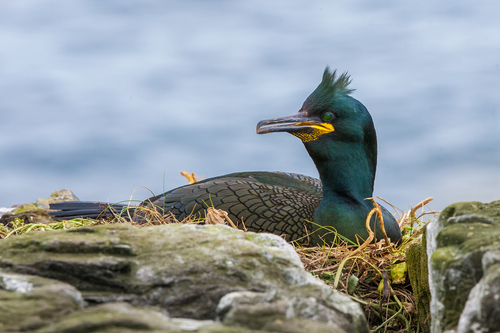


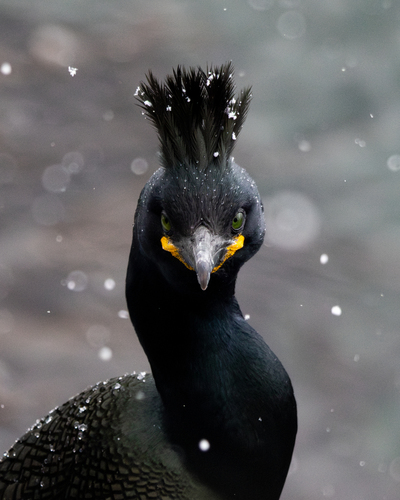
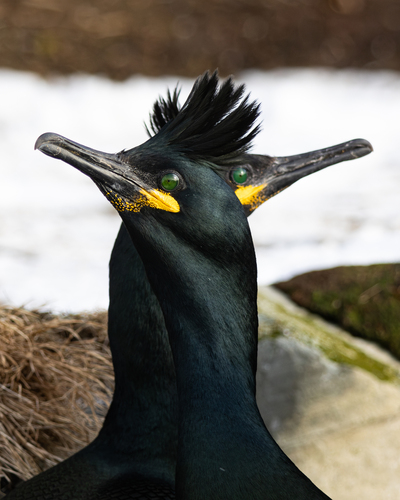
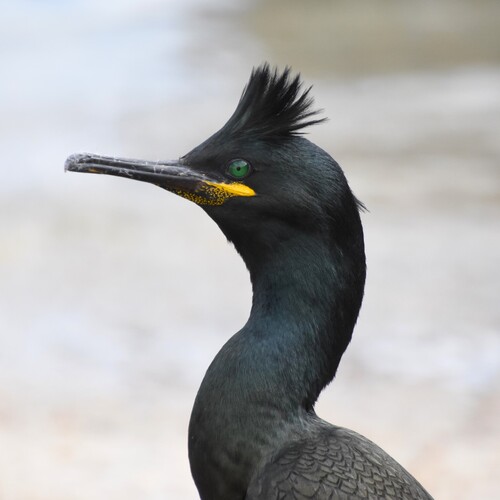
ID tip
This is a medium-large black bird, 68 to 78 cm (27 to 31 in) long and with a 95-to-110-centimetre (37 to 43 in) wingspan. It has a longish tail and a yellow throat patch. Adults have a small crest in the breeding season. It is distinguished from the great cormorant by its smaller size, lighter build, thinner bill, and, in breeding adults, by the crest and metallic green-tinged sheen on the feathers. Among those differences are that a shag is smaller and has a lighter, narrower beak, and the juvenile shag has darker underparts.
Text from Wikipedia, licensed CC BY-SA 4.0.
When to see the European Shag
One bar for each month, and every month is filled: this bird is recorded here in all twelve. The wide bar is October, the month with the most records.
Where to see the European Shag
The map shades 36 countries with regular records, and 3 more in a lighter tone where the bird turns up only as a stray. Everything unshaded has no records. Countries are listed below the map.
Recorded as a rare visitor in Switzerland, Lebanon, Luxembourg.
About the European Shag
The European shag or common shag is a species of cormorant. It is the only member of the monotypic genus Gulosus. It breeds around the rocky coasts of western and southern Europe, southwest Asia and north Africa, mainly wintering in its breeding range except for the northernmost birds. In Britain this seabird is usually referred to as simply the shag. The scientific genus name derives from the Latin for glutton. The species name aristotelis commemorates the Greek philosopher Aristotle.
Text adapted from Wikipedia, licensed CC BY-SA 4.0.
Easily confused with
 Little Black CormorantPhalacrocorax sulcirostrisThe little black cormorant is a small cormorant measuring 60–65 cm (23.5–25.5 in) with all black plumage.
 Reed CormorantMicrocarbo africanusThis is a small cormorant, 50–55 cm (20–22 in) in overall length with a wingspan of 80–90 cm (31–35 in).
 Brandt's CormorantUrile penicillatusThe average size of a Brandt's cormorant is 4.6 pounds.
Side by side: European Shag vs Little Black Cormorant · Brandt's Cormorant vs European Shag · European Shag vs Reed Cormorant
Learn the European Shag in the BeakBrain App
Photo and call practice. Coming soon to iPhone and Android.
Play today's Daily BirdEvery photo and recording on this page is credited to its author under the licence shown. Spotted a problem with this page, or have a better photo? Contribute.