Learn what every symbol on the card means.Full credits and sources at beakbrain.com/symbols
 MarinePlatform nestHuge · 2.2 kg



ID tip
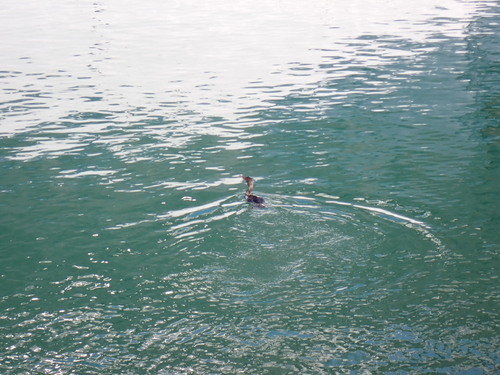
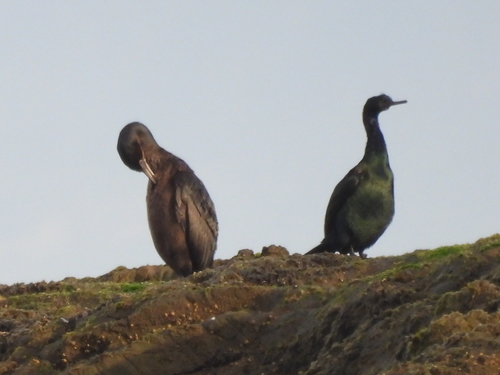
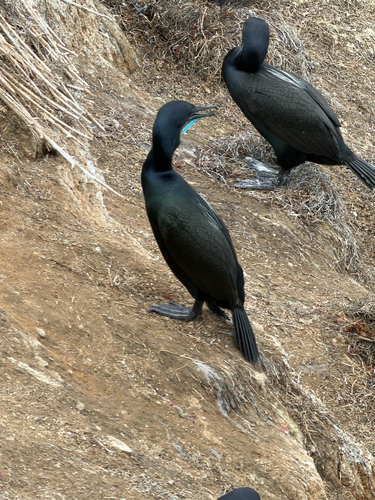
The average size of a Brandt's cormorant is 4.6 pounds. They have a length of about 34 inches and their wingspan is 4 feet. During the breeding season, adults have a blue throat patch.
Text from Wikipedia, licensed CC BY-SA 4.0.
When to see the Brandt's Cormorant
One bar for each month, and every month is filled: this bird is recorded here in all twelve. The wide bar is September, the month with the most records.
Where to see the Brandt's Cormorant
The map shades 3 countries with regular records. Everything unshaded has no records. Countries are listed below the map.
About the Brandt's Cormorant
Brandt's cormorant is a strictly marine bird of the cormorant family of seabirds that inhabits the Pacific coast of North America. It ranges, in the summer, from Alaska to the Gulf of California, but the population north of Vancouver Island migrates south during the winter. Its specific name, penicillatus is Latin for a painter's brush, in reference to white plumes on its neck and back during the early breeding season. The common name honors the German naturalist Johann Friedrich von Brandt of the Academy of Sciences at St. Petersburg, who described the species from specimens collected on expeditions to the Pacific during the early 19th century.
Text adapted from Wikipedia, licensed CC BY-SA 4.0.
Easily confused with
 Pelagic CormorantUrile pelagicusThis is a smallish cormorant which measures 25 to 35 in (64 to 89 cm) in length, with a wingspan of about 3.3 ft (1.0 m) and a weight of 52–86 oz (1,500–2,400 g) when fully grown.
 Red-faced CormorantUrile urileThe adult bird has glossy plumage that is a deep greenish blue in color, becoming purplish or bronze on the back and sides.
Side by side: Brandt's Cormorant vs Pelagic Cormorant · Brandt's Cormorant vs European Shag · Brandt's Cormorant vs Red-faced Cormorant
Learn the Brandt's Cormorant in the BeakBrain App
Photo and call practice. Coming soon to iPhone and Android.
Play today's Daily BirdEvery photo and recording on this page is credited to its author under the licence shown. Spotted a problem with this page, or have a better photo? Contribute.