Learn what every symbol on the card means.Full credits and sources at beakbrain.com/symbols
 RockyCavity nestSmall · 22 g


What the European Rock Pipit sounds like


ID tip
The European rock pipit is 16.5–17 centimetres (6.5–6.7 in) long and weighs 18–32.5 grams (0.63–1.15 oz). The nominate race has smoky-olive upperparts, weakly streaked with darker brown, and buff underparts, heavily marked with poorly defined brown streaks. The legs, bill and iris are dark brown or blackish, and there is a pale eye-ring. The sexes are alike; although males average slightly brighter than females, the overlap is complete and birds cannot be sexed on appearance or measurements.
Text from Wikipedia, licensed CC BY-SA 4.0.
When to see the European Rock Pipit
One bar for each month, and every month is filled: this bird is recorded here in all twelve. The wide bar is October, the month with the most records.
Where to see the European Rock Pipit
The map shades 22 countries with regular records, and 2 more in a lighter tone where the bird turns up only as a stray. Everything unshaded has no records. Countries are listed below the map.
About the European Rock Pipit
The European rock pipit, or simply rock pipit, is a species of small passerine bird that breeds in western Europe on rocky coasts. It has streaked greyish-brown upperparts and buff underparts, and is similar in appearance to other European pipits. There are two subspecies, of which the nominate is non-migratory, and the Fennoscandian one is migratory, wintering in shoreline habitats further west and south in Europe. The European rock pipit is territorial at least in the breeding season, and year-round where it is resident. Males will sometimes enter an adjacent territory to assist the resident in repelling an intruder, behaviour only otherwise known from the African fiddler crab.
Text adapted from Wikipedia, licensed CC BY-SA 4.0.
Easily confused with
 Water PipitAnthus spinolettaThe water pipit is 15–17 centimetres (5.9–6.7 in) long and weighs 18.7–23 grams (0.66–0.81 oz).
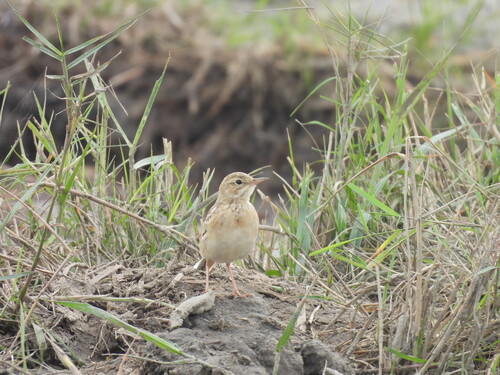 Paddyfield PipitAnthus rufulusThis is a large pipit at 15 cm, but is otherwise an undistinguished looking bird, mainly streaked grey-brown above and pale below with breast streaking.
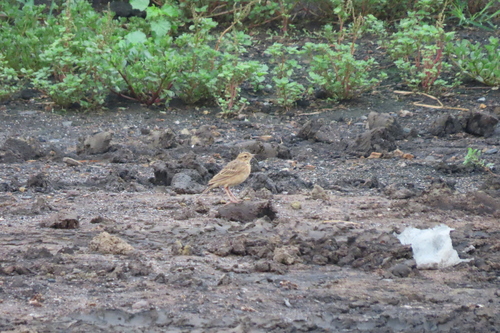 African PipitAnthus cinnamomeusThe African pipit is 15 to 17 cm (5.9 to 6.7 in) long and is a slender bird with an erect stance.
Side by side: European Rock Pipit vs Meadow Pipit · American Pipit vs European Rock Pipit · European Rock Pipit vs Tree Pipit · European Rock Pipit vs Water Pipit · European Rock Pipit vs Paddyfield Pipit · African Pipit vs European Rock Pipit
Learn the European Rock Pipit in the BeakBrain App
Photo and call practice. Coming soon to iPhone and Android.
Play today's Daily BirdEvery photo and recording on this page is credited to its author under the licence shown. Spotted a problem with this page, or have a better photo? Contribute.