Learn what every symbol on the card means.Full credits and sources at beakbrain.com/symbols
 WoodlandCavity nestMedium · 92 g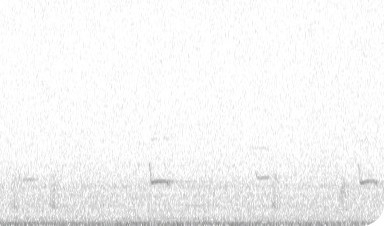


What the Eurasian Scops Owl sounds like


ID tip
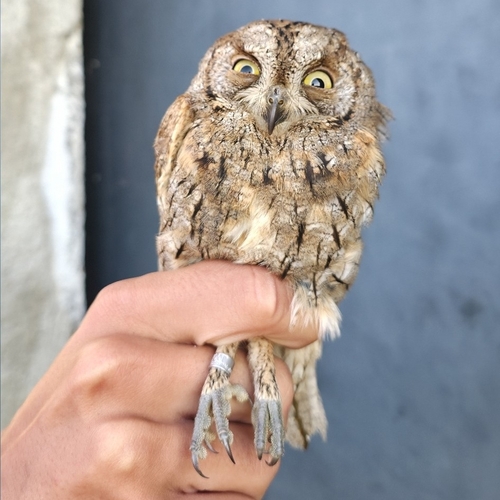
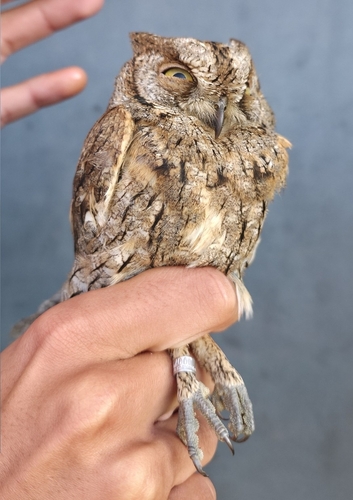
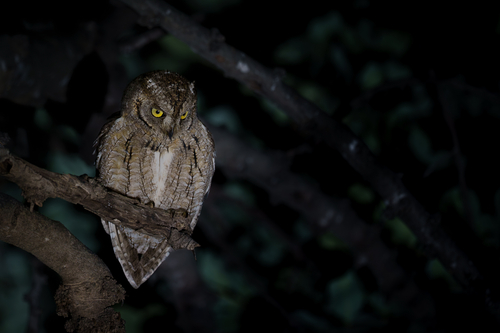
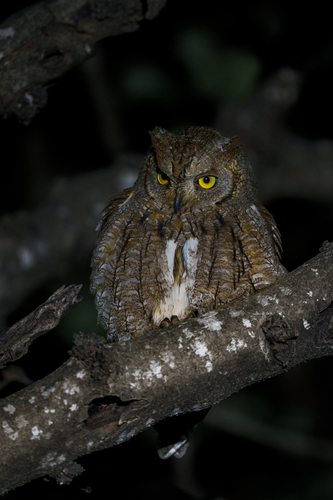
The Eurasian scops owl is 19–21 cm (7.5–8.3 in) in length with a wingspan of 47–54 cm (19–21 in). This is somewhat smaller than the little owl (Athene noctua). It perches upright and shows small ear-tufts. The plumage is predominantly grey-brown in colour, with a paler face, underparts and shoulder line. This species has a strong direct flight on long narrow wings, reflecting its migratory habits. The call is a deep whistle given by both sexes. It is similar to the call of midwife toads in the genus Alytes.
Text from Wikipedia, licensed CC BY-SA 4.0.
When to see the Eurasian Scops Owl
One bar for each month. Filled bars are the 6 months with records; pale bars are months with none. The wide bar is May, the month with the most records.
Where to see the Eurasian Scops Owl
The map shades 60 countries with regular records, and 16 more in a lighter tone where the bird turns up only as a stray. Everything unshaded has no records. Countries are listed below the map.
Recorded as a rare visitor in United Kingdom, India, Germany, Belgium, Netherlands, Finland, Japan, Ireland, Norway, Afghanistan, Cameroon, Seychelles, Bahrain, Lebanon, Denmark, Iceland.
About the Eurasian Scops Owl
The Eurasian scops owl, also known as the European scops owl, common scops owl or just scops owl, is a small owl in the typical owl family Strigidae. Its breeding range extends from southern Europe eastwards to southern Siberia and the western Himalayas. It is migratory, wintering in Africa south of the Sahara, although it is resident year-round in parts of Mediterranean Europe.
Text adapted from Wikipedia, licensed CC BY-SA 4.0.
Easily confused with
 Collared Scops OwlOtus lettiaThe collared scops owl is an owl which is a resident breeder in south Asia from northern Pakistan, northern India, Nepal, Bangladesh, the Himalayas east to southern China, and Taiwan.
 Indian Scops OwlOtus bakkamoenaThe Indian scops owl is a small 23–25 cm (9.1–9.8 in) owl, although it is one of the largest of the scops owls.
 African Scops OwlOtus senegalensisThe African scops owl is a small owl, measuring 17 cm (6.7 in) in length.
Side by side: Eurasian Scops Owl vs Indian Scops Owl · African Scops Owl vs Eurasian Scops Owl
Learn the Eurasian Scops Owl in the BeakBrain App
Photo and call practice. Coming soon to iPhone and Android.
Play today's Daily BirdEvery photo and recording on this page is credited to its author under the licence shown. Spotted a problem with this page, or have a better photo? Contribute.