Learn what every symbol on the card means.Full credits and sources at beakbrain.com/symbols
 GrasslandScrapeLarge · 803 g




What the Eurasian Curlew sounds like


ID tip
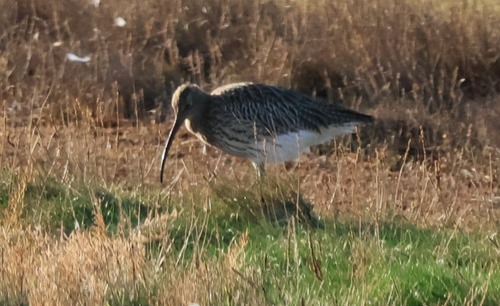
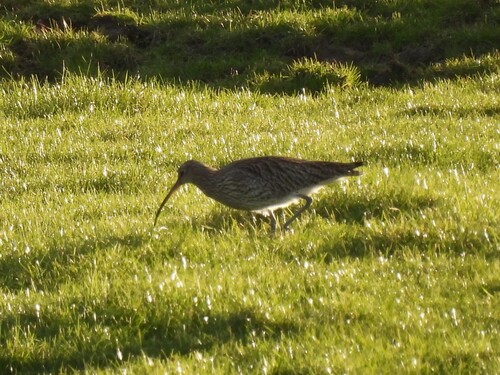
The Eurasian curlew is the largest wading bird in its range. It is 50–60 cm (20–24 in) long, has a wingspan of 89–106 cm (35–42 in) wingspan and weighs 410–1,360 g (0.90–3.00 lb). It is mainly greyish brown, with a white back, greyish-blue legs and a very long curved bill. Males and females look identical, but the bill is longest in the adult female. It is generally not possible to determine the sex of an individual Eurasian curlew, or even of several, as there is much variation. However, it is usually possible to tell the sexes apart in a mated pair. The familiar call is a loud curloo-oo.
Text from Wikipedia, licensed CC BY-SA 4.0.
When to see the Eurasian Curlew
One bar for each month, and every month is filled: this bird is recorded here in all twelve. The wide bar is April, the month with the most records.
Where to see the Eurasian Curlew
The map shades 121 countries with regular records, and 14 more in a lighter tone where the bird turns up only as a stray. Everything unshaded has no records. Countries are listed below the map.
Recorded as a rare visitor in Australia, Canada, United States, Luxembourg, Argentina, Brunei, Jordan, Kosovo, Guam, Cape Verde, Comoros, Iraq, Lebanon, Syria.
About the Eurasian Curlew
The Eurasian curlew or common curlew is a very large wader in the family Scolopacidae. It is one of the most widespread of the curlews, breeding across temperate Europe and Asia. In Europe, this species is often referred to just as the "curlew", and in Scotland known as the "whaup" in Scots.
Text adapted from Wikipedia, licensed CC BY-SA 4.0.
Easily confused with
 Eurasian WhimbrelNumenius phaeopusThe Eurasian whimbrel is a fairly large wader, though mid-sized as a member of the curlew genus.
 Long-billed CurlewNumenius americanusThe long-billed curlew is the largest sandpiper of regular occurrence in North America.
 Far Eastern CurlewNumenius madagascariensisThe Far Eastern curlew is a large wader most similar in appearance to the long-billed curlew, but slightly larger.
Side by side: Eurasian Curlew vs Eurasian Whimbrel · Eurasian Curlew vs Long-billed Curlew
Learn the Eurasian Curlew in the BeakBrain App
Photo and call practice. Coming soon to iPhone and Android.
Play today's Daily BirdEvery photo and recording on this page is credited to its author under the licence shown. Spotted a problem with this page, or have a better photo? Contribute.