Learn what every symbol on the card means.Full credits and sources at beakbrain.com/symbols
 DesertScrapeMedium · 77 g


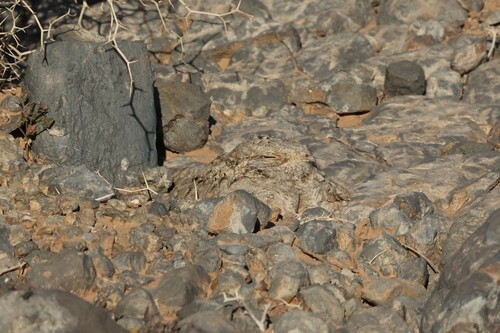
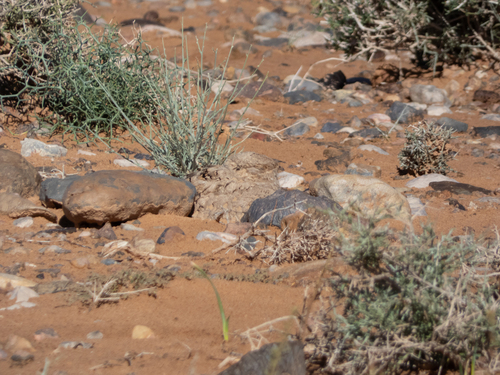
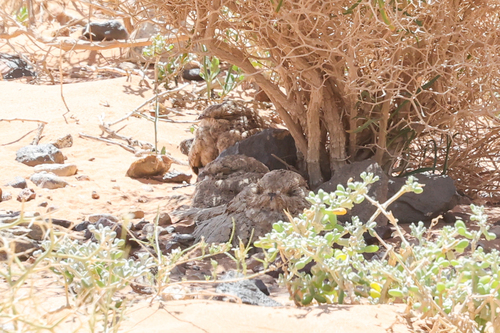
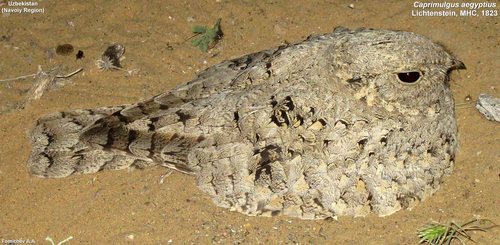
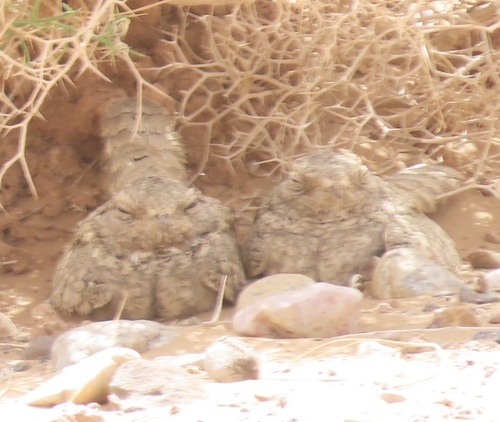
ID tip
The variegated plumage is much paler than the European nightjar. The adult is sand-coloured, barred and streaked with buff and brown. The under parts are sandy or whitish. It is smaller, but relatively longer-winged and longer-tailed than the more widespread species. Like other nightjars, it has a wide gape, long wings, soft downy plumage and nocturnal habits. The male has tiny white wing spots. The length is 25 cm, and the wingspan 55 cm. Its call is a repetitive mechanical kroo-kroo-kroo…, which rises and falls as the bird turns its head from side to side.
Text from Wikipedia, licensed CC BY-SA 4.0.
When to see the Egyptian Nightjar
One bar for each month, and every month is filled: this bird is recorded here in all twelve. The wide bar is March, the month with the most records.
Where to see the Egyptian Nightjar
The map shades 17 countries with regular records, and 2 more in a lighter tone where the bird turns up only as a stray. Everything unshaded has no records. Countries are listed below the map.
About the Egyptian Nightjar
The Egyptian nightjar is a medium-small nightjar which occurs in south west Asia and north Africa and winters in tropical Africa. This is a fairly common species with a wide distribution which faces no obvious threats apart from habitat destruction, so the International Union for Conservation of Nature has rated its conservation status as being of "least concern".
Text adapted from Wikipedia, licensed CC BY-SA 4.0.
Easily confused with
 Montane NightjarCaprimulgus poliocephalusThe montane nightjar is a rather dark nightjar growing to a length of about 23 cm (9.1 in).
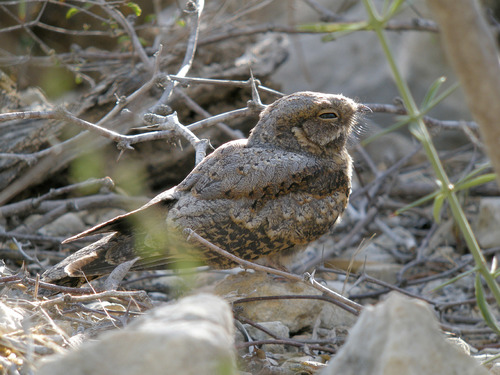 Madagascar NightjarCaprimulgus madagascariensisThe Madagascar nightjar or Madagascan nightjar is a species of nightjar in the family Caprimulgidae.
 Slender-tailed NightjarCaprimulgus clarusThe slender-tailed nightjar is a medium-sized nightjar, measuring approximately 25–28 cm in length.
Learn the Egyptian Nightjar in the BeakBrain App
Photo and call practice. Coming soon to iPhone and Android.
Play today's Daily BirdEvery photo and recording on this page is credited to its author under the licence shown. Spotted a problem with this page, or have a better photo? Contribute.