Learn what every symbol on the card means.Full credits and sources at beakbrain.com/symbols
 ForestDomed nestSmall · 49 g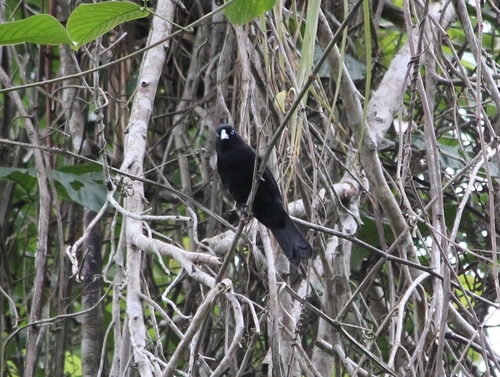


What the Ecuadorian Cacique sounds like

ID tip
The male Ecuadorian cacique grows to a length of about 23 cm (9 in), with the female being a little smaller. The plumage of both sexes is entirely black, the beak is whitish, long and pointed, and the iris is blue in adults and brown in juveniles. This bird can be distinguished from the otherwise similar solitary cacique (Cacicus solitarius) because that species is larger, has a darker-coloured iris and spends more time in undergrowth and near the ground and less time in trees. Also similar is the red-rumped cacique (C. haemorrhous), but it reveals its bright red rump patch when in flight.
Text from Wikipedia, licensed CC BY-SA 4.0.
When to see the Ecuadorian Cacique
One bar for each month, and every month is filled: this bird is recorded here in all twelve. The wide bar is December, the month with the most records.
Where to see the Ecuadorian Cacique
The map shades 2 countries with regular records, and 1 more in a lighter tone where the bird turns up only as a stray. Everything unshaded has no records. Countries are listed below the map.
Recorded as a rare visitor in Peru.
About the Ecuadorian Cacique
The Ecuadorian cacique is a species of bird in the family Icteridae. It is found in Colombia, Ecuador, and Peru, where its natural habitat is subtropical or tropical moist lowland forest. A fairly common bird with a wide range, the IUCN has rated it a "species of least concern".
Text adapted from Wikipedia, licensed CC BY-SA 4.0.
Easily confused with
 Band-tailed CaciqueCacicus latirostrisMale band-tailed caciques average about 33 cm (13 in) long and 118 g (4.2 oz).
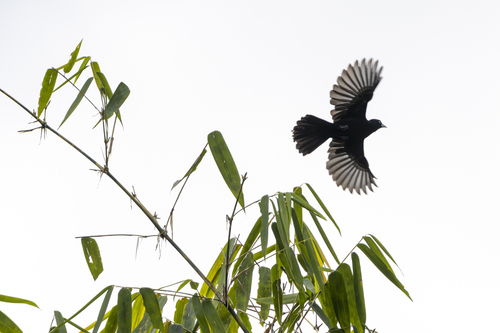 Selva CaciqueCacicus koepckeaeThe Selva cacique is entirely black except for a distinctive yellow rump and yellow upper-tail coverts.
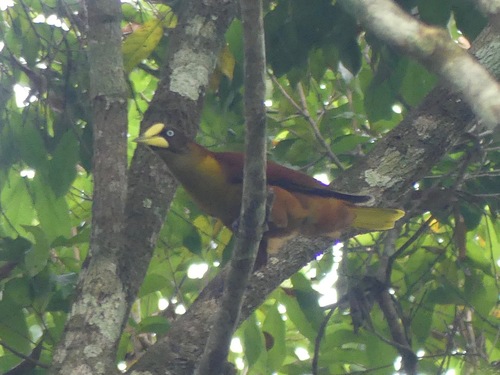 Casqued CaciqueCacicus oseryiMale casqued caciques average 37 cm (15 in) long and 188 g (6.6 oz).
Learn the Ecuadorian Cacique in the BeakBrain App
Photo and call practice. Coming soon to iPhone and Android.
Play today's Daily BirdEvery photo and recording on this page is credited to its author under the licence shown. Spotted a problem with this page, or have a better photo? Contribute.